


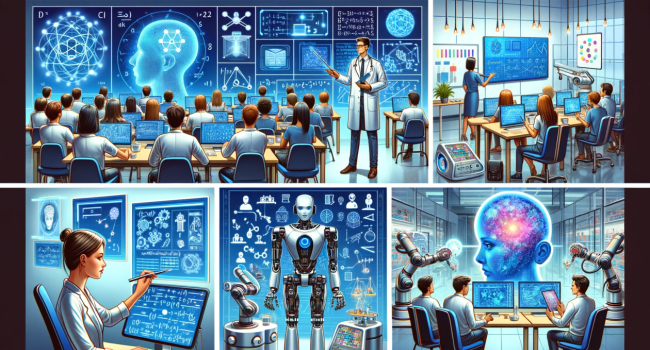
50,000 subscriptions and AI for schools: How Armenia plans to use artificial intelligence in education
Beginning in September, Armenian schools and universities will gain access to a large suite of AI-powered educational tools. As part of a collaboration with Firebird and OpenAI, the plan is to provide 50,000 subscriptions, which will be available to upper-secondary students and those in higher education.
This is not merely about access to standard ChatGPT. The Ministry of Education, Science, Culture and Sports aims to implement tools specifically designed for educational tasks, while simultaneously training teachers and school administrators in their use.
"The education system must learn to interact with artificial intelligence. This is a reality that has already become part of our lives," Minister of Education, Science, Culture and Sports Zhanna Andreasyan told journalists at a meeting.
What AI Could Do for a School Principal
One of the proposed scenarios concerns school management. Today, a principal can see student grades and attendance in the electronic system. With AI tools, these data could be further analysed to identify vulnerabilities and understand which areas require greater attention from the school.
Thus, AI should be used not only as a tool for the student but also as a means of supporting school administration.
"For example, a school principal who fully operates in the digital environment—seeing children's grades and absences in the electronic system—will also be able, with the help of AI tools, to receive analysis and understand the more vulnerable areas, the directions that need more attention," the minister explained.
Teachers Will Be Able to Spend Less Time on Routine Work
Another area is assisting educators. AI tools could be used to prepare assignments and tests, as well as for thematic planning. The idea is to offload some of the mechanical work to technology, freeing up more time for meaningful and creative activities.
At the same time, the ministry acknowledges that simply giving teachers access to new tools is not enough. Educators and principals will require guidance and training.
Andreasyan said that relevant manuals and video materials would be prepared, and a large-scale retraining process was planned.
Schools Will Have to Learn to Live with AI
The ministry views AI integration not only as a technological project but also as a major transformation of the entire educational environment.
According to Andreasyan, competent and thoughtful use of AI can benefit the education system, but without rules and a clear understanding of how to apply such tools, the technology could create new problems.
"We are confident that only competent and thoughtful solutions will make these tools serve quality education, rather than lead to the serious challenges that the entire education system worldwide is facing today," she said.
The ministry also considers it necessary to develop appropriate legislation. This direction is to be pursued jointly with the Ministry of High-Tech Industry.
AI in Schools Is Not Entirely New
The introduction of AI in Armenian schools did not begin only now. The ministry has been running the STEP AI programme in partnership with the private sector for several years. It offers comprehensive courses on artificial intelligence and is already operating in 15 schools.
Another programme, "Generation of Artificial Intelligence," is set to be expanded from September—it will be available in 39 schools.
According to the minister, such programmes not only give children new knowledge but also create opportunities for career guidance. Schoolchildren gain skills that may prove valuable in the future and become more competitive.
Results, Andreasyan said, are already visible in international competitions. This year, Armenian schoolchildren won two bronze medals at the International Olympiad in Artificial Intelligence.
The minister particularly emphasised that these results were achieved by students from public schools, including those in the regions.
Minister: It Cannot Be Assumed That a Good Education Exists Only in Yerevan
Andreasyan specifically drew attention to the performance of regional schools. In her view, discussions about education quality often create the impression that there is a clear divide between schools in the capital and those in the regions—the former showing good results and the latter lagging noticeably.
The minister considers this picture too simplistic.
"The general education system is quite multi-layered and multidimensional, and we have many regional schools that show very good results—both in the field of AI and in other areas of international Olympiads," she said.
Overall, international Olympiad results are also improving. If in 2025 Armenian schoolchildren won 91 medals at international Olympiads, then in the current year they have already earned 115 medals, with the competition season still ongoing.
For the ministry, this is an indication that student participation in international competitions across various fields is expanding, and the results of Armenian education are becoming more visible on the international stage.
The Next Step: Bringing Schoolchildren to Research Institutes
AI is only one part of a broader policy aimed at strengthening schoolchildren's interest in science.
Earlier this year, the ministry launched a programme of visits to research institutes. Initially, schoolchildren could sign up for such visits voluntarily. Now the ministry plans to make the system more organised: a platform is expected to be introduced shortly through which schools can register for visits to various research institutes.
The ministry is also considering making such visits a compulsory part of the educational programme—similar to visits to museums, concert halls, and theatres.
Andreasyan said she had personally attended many such visits and seen how children's attitudes towards science change when they have the opportunity not just to read about it in a textbook but to see scientific work with their own eyes and talk to researchers.
In her view, this can influence both schoolchildren's career orientation and their perception of the role of science in society and the state.
From School Laboratory to Real Science
This work is intended to complement another area of state policy: the government aims to equip all schools with laboratories for natural sciences and information technology.
Thus, the ministry envisions a whole chain: a child gets the opportunity to experiment and explore in their own school, then becomes acquainted with real scientific work at institutes, and simultaneously gains access to modern digital tools.
Ultimately, the goal is not just to teach schoolchildren how to use artificial intelligence. The task the ministry describes is broader: to create an educational environment in which technology, hands-on experience, and exposure to real science help children better understand their own interests and choose their future profession.
- Related News
- How to work with neural networks properly: 5 rules that actually help
- Why Bill Gates is no longer an AI optimist: Three major threats of AI
- Firebird AI Joins UATE as a Strategic Member
- Neural networks can't read minds: 4 key rules for working effectively with AI
- OpenAI prepares to go public in 2027
- AI is already solving problems that mathematicians have worked on for decades: When will it learn logical reasoning? Interview with Perouz Taslakian
- Tech Jobs
- Most read
month
week
day
- Astronomers have found the fastest star in the Milky Way—it races around a black hole at 8% of the speed of light 627
- The anniversary iPhone 20 will be as thin as the Air: what the insider revealed 585
- How NASA's primary training centre is changing in the era of commercial space stations 572
- From Excel to AI: A startup by specialists who relocated from Iran to Armenia helps businesses make sense of their data 567
- Robot knocks out teeth of five year old girl: Incident at Chinese museum leads to lengthy compensation dispute 519
- Why Bill Gates is no longer an AI optimist: Three major threats of AI 503
- How to make your new smartphone more secure: expert tips 468
- 10,000 tiny probes to Saturn's rings and robots in lunar caves: NASA funds 18 visionary ideas 449
- "Dark photons" back in play: scientists revise constraints on dark matter 443
- Martian crater from The Martian captured in new detailed video 434
- Archive