


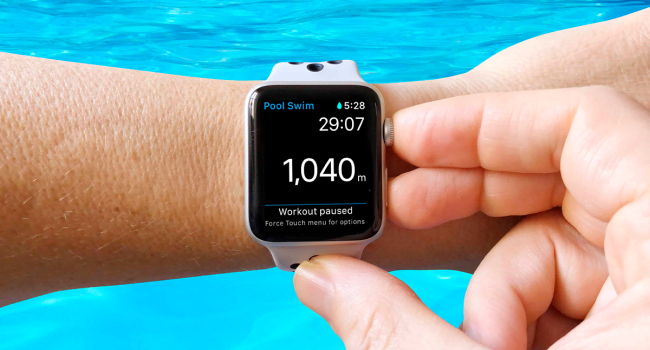
Can you swim in the sea with a smartwatch?
Almost all modern smartwatches have some form of water resistance. But that doesn't mean you can safely wear them in the sea. In practice, seawater and active swimming often lead to device failure.
What protection standards exist
Two main standards are used to indicate water resistance:
- IP (Ingress Protection) — the most common. For example, IPX7 means the device can withstand brief immersion to a depth of up to 1 meter, while IPX8 allows for deeper and longer immersion.
- WR / ATM — a more intuitive system for watches. WR50 or 5 ATM means the watch can withstand pressure at depths of up to 50 meters, WR100 or 10 ATM — up to 100 meters.
However, all of these standards are primarily designed for fresh water.
Why seawater is more dangerous than a pool
Seawater contains salt, which acts as an aggressive corrosive agent:
- Salt eats away at contacts, the speaker, microphone, and metal parts.
- Salt crystals can get under buttons and seals, compromising watertightness.
Additionally, during swimming and diving, the watch is subjected to extra pressure from waves and arm movements. Heating the watch body in the sun can also degrade the properties of the sealing gaskets.
Static and dynamic are different things
Manufacturers often specify maximum depth under static conditions. Swimming, jumping into the water, and active movement significantly increase the actual load. Therefore, even watches rated at 5 ATM do not always withstand seawater and active swimming.
Important recommendations
- After swimming in the sea, be sure to rinse the watch in fresh water.
- Do not leave the device wet — dry it thoroughly.
- Even if the watch is advertised as waterproof, it is better to take it off before swimming in the sea.
Warranty won't help
If water does get inside, service centers most often refuse warranty repairs. Proving that you did not exceed the allowable depth is practically impossible. After repair, water resistance is often compromised.
In brief
Most smartwatches have water protection designed for fresh water. Seawater with salt is significantly more aggressive and can cause corrosion. Active swimming and diving create additional pressure. Even with high stated protection (IP68, 5–10 ATM), swimming in the sea remains risky. After contact with seawater, the watch must be rinsed in fresh water and dried thoroughly. The safest approach is to take your smartwatch off before swimming in the sea.
- Related News
- Smart gadgets 2026: Five devices that truly make life easier
- What gadgets is Apple preparing for 2027?
- Apple is holding back several key iOS 27 features for the fall presentation
- Apple is preparing a successor to AirPods: Its first smart glasses are expected to arrive in 2027
- Google unveils the screen-free Fitbit Air Fitness Band
- How hackers can breach smartwatches to steal data
- Tech Jobs
- Most read
month
week
day
- Top tablets of August 2026: Experts name the best five 1257
- Top flagships of August 2026: Experts name the five best smartphones 1046
- From Excel to AI: A startup by specialists who relocated from Iran to Armenia helps businesses make sense of their data 961
- The anniversary iPhone 20 will be as thin as the Air: what the insider revealed 757
- Why Bill Gates is no longer an AI optimist: Three major threats of AI 705
- 10,000 tiny probes to Saturn's rings and robots in lunar caves: NASA funds 18 visionary ideas 626
- Robot knocks out teeth of five year old girl: Incident at Chinese museum leads to lengthy compensation dispute 619
- How NASA's primary training centre is changing in the era of commercial space stations 602
- Apple prepares to raise iPhone prices following Samsung and Google 600
- 50,000 subscriptions and AI for schools: How Armenia plans to use artificial intelligence in education 590
- Archive