


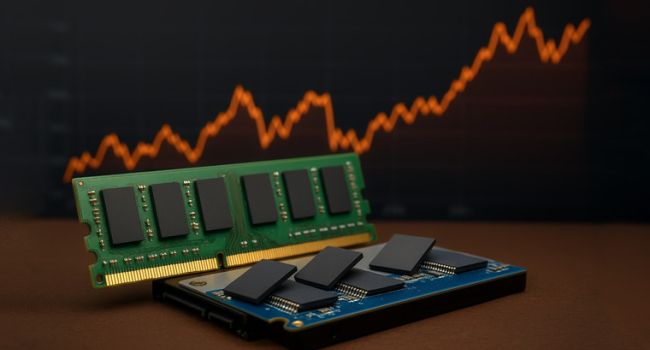
High memory prices to persist until 2028–2030: Why is Apple being blamed for the problem?
The shortage and high cost of memory, driven by the artificial intelligence boom, are likely to become a long-term issue. According to experts, cheap RAM should not be expected in the coming years, and the situation may last at least until the end of the decade.
Micron reports high prices
Micron, one of the largest memory manufacturers, has effectively withdrawn from the mass consumer market, leaving only residual stock. Instead, it is actively signing long-term "Strategic Customer Agreements" (SCA) with 16 major B2B clients for terms of up to 5 years. Clients are locking in prices at current historical highs and making advance payments.
Micron's gross margin for the reporting period reached a record 84.9%, with net profit of $28.9 billion. According to the author of the YouTube channel JayzTwoCents, the company has effectively entered into a legalized collusion with Samsung and SK Hynix to keep prices high at least until 2028–2030.
Apple's role in the crisis
Micron's Chief Business Officer Sumit Sadana hinted in an interview with The Wall Street Journal that aggressive pricing policies by certain large customers during the 2023 downturn exacerbated the problem. Although the company did not name names, experts at 9to5Mac are confident that Apple was the primary subject.
According to Sadana, some clients during the low-demand period drove prices to record lows, leading to negative profitability for manufacturers. As a result, companies were forced to cut investments in capacity expansion.
The Micron executive noted that they told a couple of clients who were very aggressive in pricing at the time that this was not constructive.
Apple has traditionally negotiated hard with suppliers and, through long-term contracts, has secured favorable terms. This strategy helped the company keep production costs low but, according to critics, contributed to shaping a market that was unfavorable for memory production expansion.
What this means for users
Ultimately, ordinary consumers are facing the consequences: laptops, smartphones, gaming consoles, and PCs continue to rise in price. As long as manufacturers' main capacities are directed toward AI servers and long-term contracts with major players lock in high prices, a return to "cheap memory" in the coming years is not expected.
In brief
High memory prices will persist at least until 2028–2030. Micron has withdrawn from the mass market and is locking in maximum prices in long-term contracts with major clients. Experts blame Apple for its aggressive pricing policy in 2023, which led to reduced investment in production, exacerbating the future shortage. As a result, cheap RAM for ordinary users is not expected in the foreseeable future.
- Related News
- Samsung unveils monitor with record-breaking 1100 Hz refresh rate
- How to recover a corrupted USB flash drive: A practical guide
- Memory shortage hits the budget market: Why are smartphones under $100 disappearing from the market?
- Expert explains why smartphone storage quietly fills up
- How much RAM do you really need for gaming in 2026
- A full-fledged DLSS equivalent is coming to smartphones
- Tech Jobs
- Most read
month
week
day
- From Excel to AI: A startup by specialists who relocated from Iran to Armenia helps businesses make sense of their data 617
- The anniversary iPhone 20 will be as thin as the Air: what the insider revealed 598
- How NASA's primary training centre is changing in the era of commercial space stations 573
- Robot knocks out teeth of five year old girl: Incident at Chinese museum leads to lengthy compensation dispute 536
- Why Bill Gates is no longer an AI optimist: Three major threats of AI 532
- Top flagships of August 2026: Experts name the five best smartphones 521
- How to make your new smartphone more secure: expert tips 474
- 10,000 tiny probes to Saturn's rings and robots in lunar caves: NASA funds 18 visionary ideas 472
- "Dark photons" back in play: scientists revise constraints on dark matter 456
- Apple prepares to raise iPhone prices following Samsung and Google 450
- Archive