


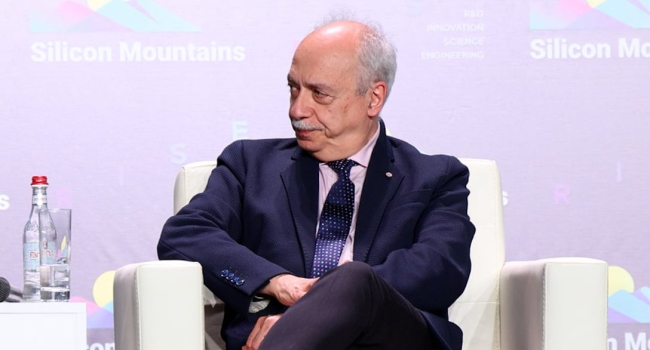
Synopsys Armenia: Armenia is ready to create globally competitive chips
In the semiconductor industry, the concept of a “local company” effectively does not exist. Any company operating in chip development must target the global market from the very beginning. This was stated by Yervant Zorian, Chairman of Synopsys Armenia and a globally recognized expert in microelectronics and semiconductor technologies, during the first Armenian defense industry exhibition RISE-2026, where NEWS.am Tech served as an information partner.
Armenia Is Already at the Forefront of Technological Development
“In the semiconductor industry, the domestic market of any country, including Armenia, is not large enough to provide the necessary scale. Therefore, all projects must be planned from the outset with international success in mind,” Zorian noted.
According to him, success in the chip industry depends on three key components: a strong team of specialists, innovative ideas, and financial resources. It is the combination of these factors that determines a company’s competitiveness in the global market.
Zorian emphasized that Armenia possesses all the prerequisites needed to develop a strong semiconductor sector. He noted that chip design work has been carried out in the country for more than 25 years, creating a solid technological foundation.
He added that Armenia now has access to the most advanced chip-design technologies. The country is already developing components using cutting-edge process technologies, and local engineers are capable of contributing to world-class semiconductor projects.
“We are on the front line of technological preparedness. Armenia already has the capability to design modern chips that meet international standards,” Zorian said.
Innovation Is the Most Important Resource
According to Zorian, the rise of artificial intelligence is already transforming chip design. Specialized software agents are emerging that can perform individual engineering tasks and interact with one another.
He noted that the industry is gradually moving toward models in which multiple intelligent systems collaborate in chip development, while human specialists oversee and manage these processes at a higher level.
“We have already reached the stage where agents are beginning to interact with one another. A kind of orchestration of intelligent systems is emerging, working together as a single mechanism,” he said.
In his view, Armenian students and engineers should actively master these technologies in order to secure leading positions in the industry in the future.
However, despite the availability of skilled professionals and a solid technological base, Zorian believes that the decisive factor for success remains the ability to generate new ideas.
He pointed out that competition in the chip industry is now extremely intense. Specialized semiconductors are being developed for autonomous vehicles, drones, artificial intelligence systems, data centers, and many other applications.
At the same time, major global technology companies are creating their own custom chip solutions. Companies such as Google, Microsoft, and Amazon are developing proprietary AI chips, making the competitive environment even more challenging.
“To earn a place in the global market, you must offer a genuinely new idea and a new approach. Without innovation, all other resources lose their significance,” he stressed.
Creating Original Technologies Instead of Copying Existing Ones
Zorian noted that developing modern semiconductors requires enormous investment. According to him, initial investments for a new chip can reach hundreds of millions of dollars, while projects in the most advanced technology segments may require several billion dollars.
However, even such substantial investments do not guarantee success without original engineering solutions.
In his view, Armenia’s mission is not to replicate existing developments but to create its own competitive technologies.
“We should not repeat other people’s innovations. Our task is to create new chips and new solutions that can compete globally and secure their place in the international market,” Zorian concluded.
- Related News
- From Excel to AI: A startup by specialists who relocated from Iran to Armenia helps businesses make sense of their data
- Firebird AI Joins UATE as a Strategic Member
- Armenians have much to offer the world: A Qatari investor on choosing startups and Armenia's potential
- Do AI data centers use water for cooling? What happens inside Firebird and other facilities
- Not everyone needs to build the next unicorn: Why the world needs more than just startups? Interview with Helmut Kranzmaier
- Four minutes that can change a startup's fate: How to prepare a pitch that actually gets heard?
- Tech Jobs
- Most read
month
week
day
- Astronomers have found the fastest star in the Milky Way—it races around a black hole at 8% of the speed of light 628
- The anniversary iPhone 20 will be as thin as the Air: what the insider revealed 587
- From Excel to AI: A startup by specialists who relocated from Iran to Armenia helps businesses make sense of their data 575
- How NASA's primary training centre is changing in the era of commercial space stations 572
- Robot knocks out teeth of five year old girl: Incident at Chinese museum leads to lengthy compensation dispute 525
- Why Bill Gates is no longer an AI optimist: Three major threats of AI 511
- How to make your new smartphone more secure: expert tips 471
- 10,000 tiny probes to Saturn's rings and robots in lunar caves: NASA funds 18 visionary ideas 455
- Top flagships of August 2026: Experts name the five best smartphones 454
- "Dark photons" back in play: scientists revise constraints on dark matter 446
- Archive