


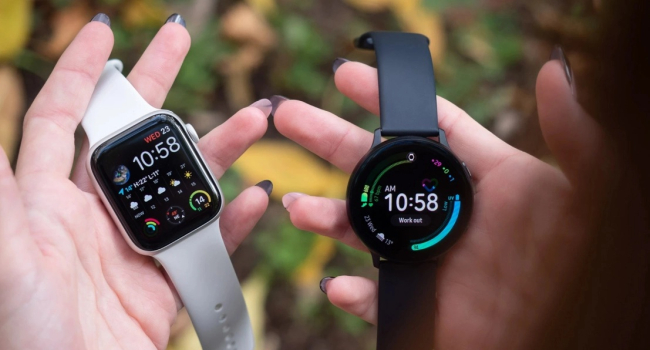
How hackers can breach smartwatches to steal data
Smartwatches, which many people use to track their health and physical activity, can become convenient targets for cybercriminals. Hackers are capable of gaining access to sensitive user data and even using it for blackmail, as Dmitry Galov, head of Kaspersky GReAT, warned in an interview with RIA Novosti.
The Main Target Is Not the Device but the Data
According to the expert, technically hacking the smartwatch itself is possible, but in practice attackers more often target not the gadget, but the cloud services and accounts connected to it.
Dmitry Galov explained that attackers look for users with improperly configured privacy settings who openly share their geolocation and other confidential information.
Applications related to fitness and health, which are usually connected to smartwatches, are of particular value to hackers. These applications collect large volumes of data, including heart rate, number of steps, distance traveled, elevation changes, and, most importantly, geolocation during outdoor workouts.
The expert noted that location and route data could be used for surveillance or stalking, while information about health and physical activity could be used in social engineering schemes or even for blackmail.
How Compromise Occurs
Most often, access to an account is obtained through standard phishing attacks. Attackers may also exploit weak passwords, data leaks from other services, or errors in privacy settings. If an account is compromised, a hacker gains access to the user’s entire workout history, routes, and biometric indicators.
Although there are no separate statistics specifically on smartwatch hacking, the risks should not be underestimated. Estimates suggest that about 70 percent of smartwatch owners use them to monitor their health. Even rare vulnerabilities or user inattention could affect a significant number of people.
How to Protect Your Data
Dmitry Galov recommends focusing first not on the device itself, but on the associated accounts and privacy settings:
- Carefully review the privacy policy of an application before installing it;
- Check what data is collected, for what purpose, and whether it is shared with third parties;
- Regularly check whether the service has experienced data breaches in the past;
- Use strong, unique passwords and enable two-factor authentication;
- Minimize the sharing of sensitive data (especially geolocation) with open or poorly protected services.
In Brief
Smartwatches can become a source of personal data leaks because they are connected to health and fitness applications that collect detailed information about heart rate, routes, and user activity. According to Kaspersky GReAT expert Dmitry Galov, hackers more often target cloud service accounts rather than the devices themselves, typically using phishing or exploiting incorrect privacy settings. The obtained data may be used for surveillance, social engineering, or blackmail. To reduce risks, users should carefully review application privacy policies, use strong account protection, and minimize the sharing of sensitive information.
- Related News
- Can you swim in the sea with a smartwatch?
- Smart gadgets 2026: Five devices that truly make life easier
- What gadgets is Apple preparing for 2027?
- Apple is holding back several key iOS 27 features for the fall presentation
- Apple is preparing a successor to AirPods: Its first smart glasses are expected to arrive in 2027
- Google unveils the screen-free Fitbit Air Fitness Band
- Tech Jobs
- Most read
month
week
day
- Earth’s microbes may survive on the Moon. Even a bootprint is enough to shield them 644
- Firebird AI Joins UATE as a Strategic Member 644
- Astronomers have found the fastest star in the Milky Way—it races around a black hole at 8% of the speed of light 627
- Quantum entanglement has been achieved directly from sunlight for the first time 614
- The anniversary iPhone 20 will be as thin as the Air: what the insider revealed 572
- How NASA's primary training centre is changing in the era of commercial space stations 568
- From Excel to AI: A startup by specialists who relocated from Iran to Armenia helps businesses make sense of their data 535
- Robot knocks out teeth of five year old girl: Incident at Chinese museum leads to lengthy compensation dispute 497
- Why Bill Gates is no longer an AI optimist: Three major threats of AI 478
- How to make your new smartphone more secure: expert tips 457
- Archive