


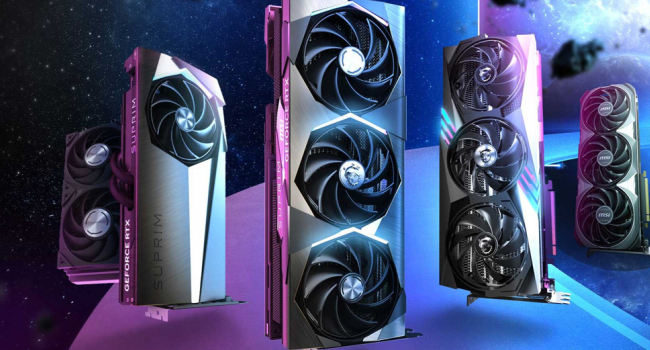
NVIDIA chip shortage will push GPU prices up: MSI warns of 15–30% increase
MSI has officially confirmed what the market has been hinting at for months: NVIDIA is supplying about 20% fewer GPU chips than current demand requires. This is directly tied to the global memory crisis (DRAM and NAND), which has now spread across the entire supply chain.
In its investor report, MSI warns that graphics card prices will rise by 15–30%, while product lineup and sales strategy will be significantly adjusted. The report was highlighted by Videocardz.
Why there is a shortage of chips
The memory crisis—driven by massive demand from AI companies like NVIDIA, Google, and Meta—has forced manufacturers to redirect production capacity toward higher-margin products such as:
- HBM memory for AI accelerators
- enterprise-grade SSDs
As a result, consumer-grade components like GDDR6/GDDR6X and NAND used in graphics cards are now in short supply.
According to MSI, NVIDIA is already about 20% behind market demand, meaning there simply won’t be enough GPUs available even if production stays at current levels.
What buyers can expect
To compensate for the shortage, MSI plans to raise prices by 15–30%, depending on the model and region. This is not a temporary spike, but a structural adjustment due to limited supply.
The company also intends to shift its product strategy:
- reduce production of entry-level GPUs (like GeForce RTX 4060)
- focus on higher-margin models such as GeForce RTX 4070 Ti Super, GeForce RTX 4080 Super, GeForce RTX 4090, and future RTX 50-series cards
This is a typical industry response to shortages: prioritize premium products where margins are higher and volumes lower.
Falling PC demand and impact on gamers
MSI also forecasts a 10–20% decline in PC sales, which is worse than many analysts previously expected.
High prices for components—especially GPUs and memory—are pushing users to:
- delay upgrades
- or skip buying new PCs altogether
At Game Developers Conference 2026, developers already acknowledged that the memory shortage could last another 1.5–2 years. Many studios are adapting by lowering system requirements—for example, Lego Batman: Legacy of the Dark Knight reduced recommended RAM from 32 GB to 16 GB.
In brief
MSI confirmed that NVIDIA is supplying 20% fewer GPU chips than the market demands due to the global memory crisis.
As a result:
- GPU prices are expected to rise by 15–30%
- budget models will become less common
- manufacturers will focus on premium cards
The company also expects PC sales to drop by 10–20%, while the shortage is likely to continue for 1.5–2 years, meaning upcoming GPU generations may also launch at higher prices and lower availability.
- Related News
- Samsung unveils monitor with record-breaking 1100 Hz refresh rate
- How to recover a corrupted USB flash drive: A practical guide
- Memory shortage hits the budget market: Why are smartphones under $100 disappearing from the market?
- Expert explains why smartphone storage quietly fills up
- How much RAM do you really need for gaming in 2026
- A full-fledged DLSS equivalent is coming to smartphones
- Tech Jobs
- Most read
month
week
day
- Two comets will be visible in Autumn 2026 1255
- DeepSeek or ChatGPT: Which is better in 2026? 1033
- NASA successfully launches Nancy Grace Roman space telescope – "Hubble's successor" 666
- Anthropic teaches AI to control real-world machines 650
- New Apple CEO to refresh top management team: What we know 634
- Scientists have learned to transmit data by laser through atmospheric disturbances 621
- Cosmonaut Harutyun Kiviryan passes pre-flight exam on ISS simulator 621
- Beijing opens "Kindergarten" for robots: Machines learn from their own mistakes 601
- What will happen to the human body on Mars? 586
- Dark matter detector captures the weakest neutrinos ever detected 547
- Archive