


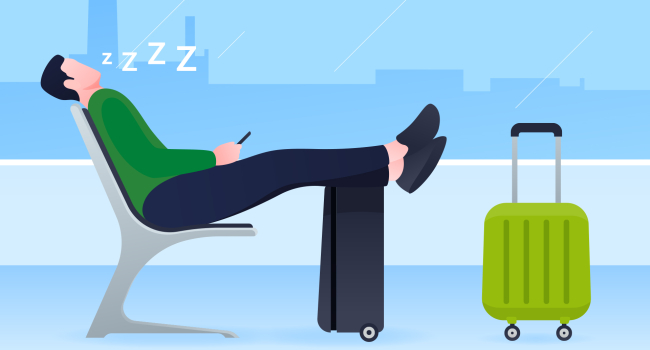
How to beat jet lag with AI: Simple plan from expert
Jet lag occurs when the body’s internal clock struggles to adjust to a new time zone after a long flight. Fatigue, sleep problems, irritability, and digestive issues are familiar to anyone who has traveled across three or more time zones.
Mikhail Ostroverkhiy, head of user products at Yandex Travel, explained in an interview with Gazeta.Ru how common AI tools — such as ChatGPT, Gemini, Alice AI, DeepSeek, and others — can create a personalized adaptation plan in just a few minutes.
Why long flights disrupt the body
When traveling east, the body typically needs about one day to adjust for every hour of time difference. Traveling west tends to be easier, but the first few days can still be challenging.
According to experts, the three main factors that influence recovery from jet lag are:
- sleep
- light exposure
- nutrition
Effective jet lag strategies are built around adjusting these elements.
How AI can create a personalized plan
To get a tailored plan, you can simply send an AI assistant a prompt like this:
“I’m flying from Yerevan to New York on March 15. Departure is at 14:00 and arrival is at 18:00 local time. My usual sleep schedule is midnight to 8:00 a.m. Please create a plan to help me adjust to the new time zone: when to sleep and wake up before the flight, during the flight, and for the first three days after arrival. Include advice on light exposure, food, and physical activity. I have no chronic illnesses or bad habits.”
The AI will analyze several factors, including:
- the direction of travel (east or west)
- departure and arrival times
- the number of connections
- your usual sleep schedule
- your health condition, if specified
Based on this information, the system can suggest:
- gradually shifting your sleep schedule 3–5 days before departure
- adjusting light exposure (bright light in the morning or evening depending on the needed shift)
- modifying meal timing and caffeine intake
- recommendations on when to sleep during the flight
- a structured routine for the first few days after arrival
Example of an AI-generated plan
For a flight from Yerevan (+4) to New York (−5) — a 9-hour westward time difference — an AI assistant might suggest:
- Four days before departure: go to bed 1–1.5 hours later each day and expose yourself to brighter light in the evening.
- During the flight: sleep during the first 4–5 hours, then stay awake and eat light meals.
- After arrival: get daylight exposure immediately, avoid daytime naps, and go to sleep around 10–11 p.m. local time.
Ostroverkhiy emphasized that the more detailed your information about your schedule and flight conditions, the more accurate the AI’s recommendations will be.
Additional expert tips
The expert also shared several simple strategies that help reduce jet lag:
- Stay hydrated — dehydration during flights can worsen symptoms.
- Avoid alcohol and heavy meals while flying.
- Move regularly — short walks in the cabin or light stretching can help circulation.
- Use light strategically: more daylight after westbound flights, and controlled light exposure after eastbound flights.
In brief
AI tools such as ChatGPT, Gemini, and Alice AI can generate a personalized jet lag recovery plan within minutes. By providing your travel route, flight schedule, and typical sleep routine, the system can recommend when to adjust sleep, how to manage the flight itself, and how to adapt during the first days at your destination. The key factors are sleep timing, light exposure, and nutrition. Travel to the west usually allows faster adaptation, while eastbound flights typically require about one day of adjustment per hour of time difference. AI-generated plans can make the first days after arrival significantly easier.
- Related News
- Beijing opens "Kindergarten" for robots: Machines learn from their own mistakes
- Anthropic teaches AI to control real-world machines
- DeepSeek or ChatGPT: Which is better in 2026?
- What Claude can do: A complete overview of one of the most popular AI assistants
- 50,000 subscriptions and AI for schools: How Armenia plans to use artificial intelligence in education
- How to work with neural networks properly: 5 rules that actually help
- Tech Jobs
- Most read
month
week
day
- Two comets will be visible in Autumn 2026 1252
- DeepSeek or ChatGPT: Which is better in 2026? 1026
- NASA successfully launches Nancy Grace Roman space telescope – "Hubble's successor" 666
- Anthropic teaches AI to control real-world machines 650
- New Apple CEO to refresh top management team: What we know 634
- Scientists have learned to transmit data by laser through atmospheric disturbances 620
- Cosmonaut Harutyun Kiviryan passes pre-flight exam on ISS simulator 620
- Beijing opens "Kindergarten" for robots: Machines learn from their own mistakes 600
- What will happen to the human body on Mars? 585
- Dark matter detector captures the weakest neutrinos ever detected 544
- Archive