


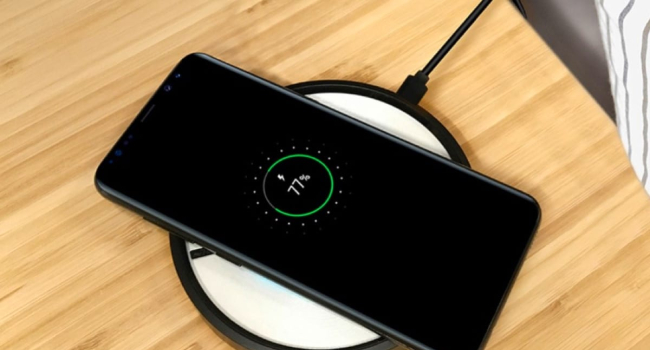
How wireless charging works for smartphones, earbuds, and watches
Wireless charging has long moved beyond being a “flagship-only” feature and has become common even in affordable gadgets. Many people place their phone on a charging pad before bed, charge earbuds in their case, or set a smartwatch on its dock — without thinking about how energy “jumps” from one surface to another without wires. In reality, the process is quite simple and based on physics discovered back in the 19th century.
Principle of Operation: Electromagnetic Induction
Wireless charging is based on a phenomenon discovered in 1831 by Michael Faraday. He proved that when a magnetic field inside a coil changes, an electric current is generated in that coil. This is known as electromagnetic induction.
Inside a charging station (pad or stand) there is a transmitting coil. An alternating current flows through it, creating a changing magnetic field. Inside a smartphone, earbuds case, or smartwatch there is a second coil — the receiving coil. When it enters this magnetic field, a current is induced in it as well. That current is then converted into direct current and used to charge the battery.
A simple home experiment demonstrates the principle:
Take a refrigerator magnet.
Connect a small light bulb to a simple copper coil.
Move the magnet back and forth inside the coil.
The bulb will light up.
The magnet creates a changing magnetic field → current appears in the coil. In wireless charging, the magnet is replaced by the transmitting coil, and the light bulb is replaced by the smartphone battery.
How It’s Implemented in Modern Gadgets
The Qi standard (pronounced “chee”) is the main global wireless charging standard. It ensures that any Qi-compatible smartphone can charge on any Qi-certified charger.
In addition to power transfer, a small amount of data — up to 2 KB/s — is exchanged through the same channel. This allows devices to “negotiate”:
- How much power to use
• Whether the phone is properly positioned on the pad
• The current battery level
Because of this communication, a charger will not attempt to push more power than the device can handle. If a smartphone supports only 15 W, the charging station will not supply 30–50 W, which could otherwise cause overheating.
MagSafe on iPhone
Apple uses not just Qi but MagSafe — a magnetic wireless charging system. Magnets inside both the charger and the smartphone (or case) precisely align the coils.
This reduces energy loss, allows higher power delivery (up to 15–25 W depending on the model), and makes charging possible even in situations like mounting a phone on a car vent holder.
Most Android smartphones require special magnetic cases to achieve similar alignment precision.
Is Wireless Charging Safe?
When using high-quality chargers and accessories — yes, it is safe. Modern devices include multiple protection systems:
- Overheating protection
• Overcurrent protection
• Foreign object detection (metal objects on the pad automatically stop charging)
However, there are simple best practices to follow:
Place the device centered on the charging pad. Even slight misalignment increases energy loss and heat.
Avoid leaving the phone charging all night — charging during the day is preferable. Prolonged time at 100 percent combined with elevated temperature reduces battery lifespan.
Do not use very cheap, unbranded chargers or damaged cables — they may deliver unstable voltage or overheat.
In Brief
Wireless charging works through electromagnetic induction: alternating current in the charger’s coil creates a changing magnetic field, which induces current in the smartphone’s receiving coil. The Qi standard ensures compatibility and safety, while Apple’s MagSafe adds magnetic alignment for better efficiency. A small data exchange allows devices to regulate power and prevent overheating. When using quality accessories and proper positioning, wireless charging is safe — though it is still better not to leave devices charging overnight and to ensure accurate placement on the pad.
- Related News
- Top flagships of August 2026: Experts name the five best smartphones
- A simple way to spend less time on your phone: Choosing your own goals?
- Foldable iPhone appeals to almost no one: Three-quarters of Americans don't want one
- The anniversary iPhone 20 will be as thin as the Air: what the insider revealed
- Apple prepares to raise iPhone prices following Samsung and Google
- What you must do before disposing of or selling your smartphone: useful tips
- Tech Jobs
- Most read
month
week
day
- The anniversary iPhone 20 will be as thin as the Air: what the insider revealed 589
- From Excel to AI: A startup by specialists who relocated from Iran to Armenia helps businesses make sense of their data 578
- How NASA's primary training centre is changing in the era of commercial space stations 572
- Robot knocks out teeth of five year old girl: Incident at Chinese museum leads to lengthy compensation dispute 526
- Why Bill Gates is no longer an AI optimist: Three major threats of AI 515
- How to make your new smartphone more secure: expert tips 471
- Top flagships of August 2026: Experts name the five best smartphones 459
- 10,000 tiny probes to Saturn's rings and robots in lunar caves: NASA funds 18 visionary ideas 456
- "Dark photons" back in play: scientists revise constraints on dark matter 447
- Martian crater from The Martian captured in new detailed video 437
- Archive