


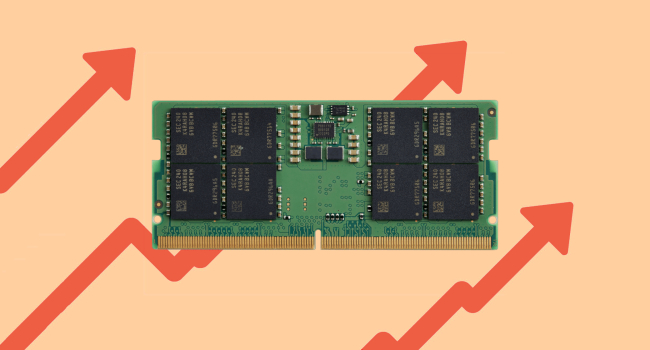
Intel chief predicts how long the computer memory shortage will last
The RAM and storage market is going through one of its most prolonged crises in recent years. Prices for DDR5, DDR4, and SSDs have already risen noticeably, while availability is declining — and improvement is not expected anytime soon. This sobering forecast was voiced by Intel CEO Lip-Bu Tan at a Cisco Systems conference.
A Firsthand Forecast
According to Tan, he personally spoke with representatives of two of the world’s largest memory manufacturers (likely Samsung and SK hynix, though he did not name them). Their assessments align: “There’s no relief until 2028.” In other words, the shortage is expected to persist for at least another two to three years, and memory prices for PCs, laptops, and consoles will likely remain high or even continue to climb.
Why It’s Happening
The root cause is the artificial intelligence boom. Since late 2025, major corporations — including Microsoft, Google, Meta, and Amazon — have sharply increased purchases of high-performance memory, primarily HBM (High Bandwidth Memory) and server-grade DRAM, for AI data centers. Manufacturers are redirecting production capacity toward this segment, where margins are higher and order volumes are massive.
As a result:
- Standard consumer memory (for PCs, gaming systems, and smartphones) is getting fewer production lines.
- Inventories are shrinking while prices rise.
- What began in the second half of 2025 quickly escalated into a systemic shortage.
Shifts in Manufacturer Strategy
The industry is already adapting to the new reality. One of the clearest examples is Micron Technology. In early December 2025, the company announced a complete exit from the consumer segment under the Crucial brand. By February 2026, retail sales of Crucial memory modules and SSDs are expected to stop, with all resources redirected toward enterprise clients, data centers, and AI projects.
This is not an isolated case: Samsung and SK hynix are also ramping up production of HBM and server memory, sacrificing part of the consumer market in the process.
What It Means for Gamers and Everyday Users
For anyone building a PC or upgrading a laptop, the outlook is grim. DDR5 kits with capacities of 32–64 GB already cost significantly more than a year ago, and the shortage is only making matters worse. Another possible consequence is delays in the release of next-generation consoles (Xbox, PlayStation, or Nintendo), as manufacturers may revise their plans to avoid sky-high component costs.
Overall, as AI giants purchase memory in massive quantities, ordinary users are left with two choices: pay more or postpone upgrades.
In Brief
Intel CEO Lip-Bu Tan warns that the computer memory shortage will last at least until 2028, with no relief in sight. The cause is explosive demand from AI data centers, which is pulling production capacity away from the consumer segment. Micron has already exited the retail market under the Crucial brand, and RAM and SSD prices are expected to remain elevated. For gamers and PC builders, this means upgrades will be more expensive — and waiting for prices to fall could take several years.
- Related News
- Samsung unveils monitor with record-breaking 1100 Hz refresh rate
- How to recover a corrupted USB flash drive: A practical guide
- Memory shortage hits the budget market: Why are smartphones under $100 disappearing from the market?
- Expert explains why smartphone storage quietly fills up
- How much RAM do you really need for gaming in 2026
- A full-fledged DLSS equivalent is coming to smartphones
- Tech Jobs
- Most read
month
week
day
- Two comets will be visible in Autumn 2026 1258
- DeepSeek or ChatGPT: Which is better in 2026? 1037
- NASA successfully launches Nancy Grace Roman space telescope – "Hubble's successor" 666
- Anthropic teaches AI to control real-world machines 650
- New Apple CEO to refresh top management team: What we know 634
- Scientists have learned to transmit data by laser through atmospheric disturbances 622
- Cosmonaut Harutyun Kiviryan passes pre-flight exam on ISS simulator 622
- Beijing opens "Kindergarten" for robots: Machines learn from their own mistakes 602
- What will happen to the human body on Mars? 587
- Dark matter detector captures the weakest neutrinos ever detected 549
- Archive