


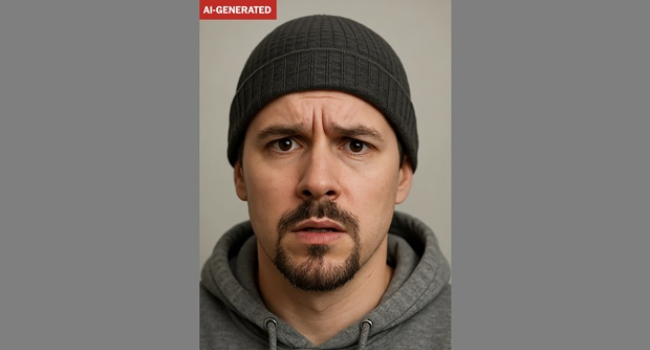
US police begin using AI instead of traditional composite sketches
In the American city of Goodyear, Arizona, police published a “composite sketch” of a shooting suspect — a realistic image of a middle-aged man in a hoodie and beanie. The caption clarified that the picture had been generated by AI based on witness testimonies and did not depict a real person. Officer Mike Bonasera, who had drawn composite sketches by hand for five years, now uploads his sketches into ChatGPT and receives almost photographic portraits.
Why They Switched to AI
Bonasera explained that traditional pencil sketches no longer attract much attention. He noted that people nowadays tend to scroll past hand-drawn images. In contrast, realistic AI-generated pictures receive far more engagement, especially from younger audiences.
The process itself remains the same: the officer conducts a detailed witness interview and produces a hand sketch, which is then uploaded into the AI system. The witness sits next to him and adjusts the result in real time — changing facial expression, hairstyle, or clothing. In one case, a witness insisted that the suspect should have a “shocked” look, and the AI image was adjusted accordingly.
After the first AI composite was published in April 2025 during a kidnapping attempt investigation, the department received a flood of calls. This convinced the leadership to continue the experiment.
Risks and Criticism
Experts warn that AI composites may worsen the already unreliable process of eyewitness memory-based identification. Brian Schwartz from the University of Arizona pointed out that generative models are trained on billions of images, many of which overrepresent certain racial groups, and this may distort outcomes. Andrew Ferguson from George Washington University added that a human sketch artist can explain every stroke in court, while the workings of AI remain opaque.
For now, AI-generated images are used only to collect leads and not as grounds for arrest. However, other departments are already expressing interest in Goodyear’s experience, and Bonasera intends to transition fully to AI.
In Brief
Police in Goodyear, Arizona have become one of the first in the US to replace hand-drawn composite sketches with AI-generated images that look nearly photographic. The officer still makes an initial sketch, uploads it to AI, and refines it together with the witness. The method generates far more leads but raises concerns: AI models may amplify existing biases and complicate legal defense. For now, the technology is used solely as an investigative tool.
- Related News
- Beijing opens "Kindergarten" for robots: Machines learn from their own mistakes
- Anthropic teaches AI to control real-world machines
- DeepSeek or ChatGPT: Which is better in 2026?
- What Claude can do: A complete overview of one of the most popular AI assistants
- 50,000 subscriptions and AI for schools: How Armenia plans to use artificial intelligence in education
- How to work with neural networks properly: 5 rules that actually help
- Tech Jobs
- Most read
month
week
day
- Two comets will be visible in Autumn 2026 1258
- DeepSeek or ChatGPT: Which is better in 2026? 1036
- NASA successfully launches Nancy Grace Roman space telescope – "Hubble's successor" 666
- Anthropic teaches AI to control real-world machines 650
- New Apple CEO to refresh top management team: What we know 634
- Scientists have learned to transmit data by laser through atmospheric disturbances 622
- Cosmonaut Harutyun Kiviryan passes pre-flight exam on ISS simulator 622
- Beijing opens "Kindergarten" for robots: Machines learn from their own mistakes 602
- What will happen to the human body on Mars? 587
- Dark matter detector captures the weakest neutrinos ever detected 549
- Archive