


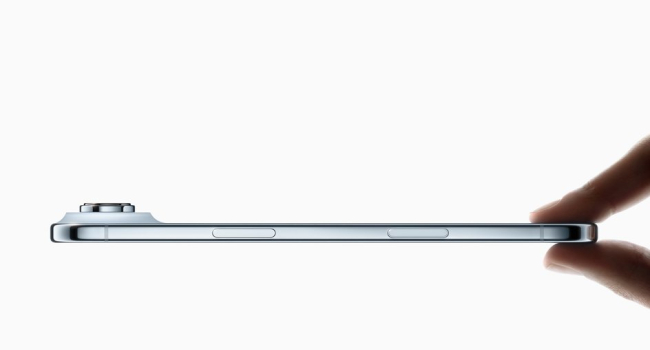
The failure of the iPhone Air: Why ultra thin smartphones are unwanted
Apple expected the iPhone Air, with its thickness of only 5.6 millimeters, to become a new hit emphasizing aesthetics and compactness. But reality proved harsher. Since September 2025, the model’s sales have collapsed, forcing the company and its suppliers to halt production. This is not only a setback for Apple but also a wake up call for the entire industry. Chinese giants such as Xiaomi, Oppo, and Vivo are canceling their plans for ultra thin devices. DigiTimes and MacRumors report that the market has made its position clear: style does not justify sacrifices to battery life and cameras.
What went wrong with the iPhone Air
The iPhone Air was presented as the first major redesign of the iPhone since the iPhone X of 2017: a minimalist look, a lightweight body, and tablet like thinness. But to reach 5.6 millimeters, engineers had to compromise: a 3200 mAh battery (compared to more than 4500 mAh in the Pro models), a single 48 MP rear camera without a telephoto lens, and reduced 5G support. The starting price was 999 dollars, only one hundred dollars cheaper than the iPhone 17 Pro, yet it offered noticeably worse battery life (only twelve to fourteen hours of screen time) and lacked premium features such as ProMotion.
The result was that demand fell seventy to eighty percent below expectations. Suppliers Foxconn and Luxshare dismantled their assembly lines entirely by the end of October 2025, and Apple cut shipments by eighty percent by year’s end. According to The Information, the company has postponed the second generation of the iPhone Air indefinitely, possibly until 2027 or perhaps abandoning the idea altogether. DxOMark analysts noted that the Air’s camera is inferior even to the iPhone 15, and its battery life scores lag behind the Google Pixel 8.
A chain reaction: Chinese manufacturers cancel their "Air" models
Apple’s failure became a signal to competitors. Chinese brands preparing ultra thin models to respond to the iPhone Air are now revising their plans:
- Xiaomi: its "true Air" (5.9 millimeters thick) was nearly finished, but the project is frozen, with resources diverted to the Mi 15 series focusing on batteries above 6000 mAh.
• Oppo and Vivo: their mid range S lines (for example, Vivo S50 Pro Mini) and the Find X8 Slim planned thicknesses of around 6 millimeters, but development has been halted. eSIM modules designed for them are being used in other product lines.
• Samsung: the Galaxy S25 Edge (5.8 millimeters) also failed in the summer, leading to the cancellation of the S26 Edge. The company is returning to thicker flagships with an emphasis on AI and cameras.
According to Sina Finance and Jiemian, this is a ripple effect. Chinese vendors saw that consumers are unwilling to pay a premium for compromises. In China, where the ultra thin gadget market had been growing, sales of such devices fell sixty percent in a single quarter.
Why thinness became a disadvantage
Ultra thin smartphones look appealing, but the sacrifices are obvious: smaller batteries (twenty to thirty percent less capacity), reduced cameras (no periscope lenses or LiDAR), and limited heat dissipation resulting in slowdowns in games and AI tasks. In 2025, when flagship models such as the Xiaomi 15 Pro offer 7000 mAh batteries and 200 MP cameras for the same nine hundred to one thousand dollars, the philosophy of "style at the cost of functionality" no longer sells. Analysts from Mix Vale and NotebookCheck emphasize that the market is shifting toward balance. Thinness matters, but not at the expense of practicality.
In short
The iPhone Air (5.6 millimeters thick) failed, with sales seventy to eighty percent below expectations due to its weak 3200 mAh battery and single camera at a price of 999 dollars. Apple has postponed the second generation, and Chinese companies (Xiaomi, Oppo, Vivo) have canceled their ultra thin projects, redirecting resources to more functional models. Samsung has also scrapped the S26 Edge. The market has spoken: thinness is appealing, but not at the cost of battery life and cameras. The future lies in balance, not extremes.
- Related News
- Blue light from screens: Is it really dangerous for eyes, and what should you know?
- Top flagships of August 2026: Experts name the five best smartphones
- A simple way to spend less time on your phone: Choosing your own goals?
- Foldable iPhone appeals to almost no one: Three-quarters of Americans don't want one
- The anniversary iPhone 20 will be as thin as the Air: what the insider revealed
- Apple prepares to raise iPhone prices following Samsung and Google
- Tech Jobs
- Most read
month
week
day
- Two comets will be visible in Autumn 2026 1258
- DeepSeek or ChatGPT: Which is better in 2026? 1038
- NASA successfully launches Nancy Grace Roman space telescope – "Hubble's successor" 666
- Anthropic teaches AI to control real-world machines 650
- New Apple CEO to refresh top management team: What we know 634
- Scientists have learned to transmit data by laser through atmospheric disturbances 623
- Cosmonaut Harutyun Kiviryan passes pre-flight exam on ISS simulator 623
- Beijing opens "Kindergarten" for robots: Machines learn from their own mistakes 603
- What will happen to the human body on Mars? 588
- Dark matter detector captures the weakest neutrinos ever detected 550
- Archive