


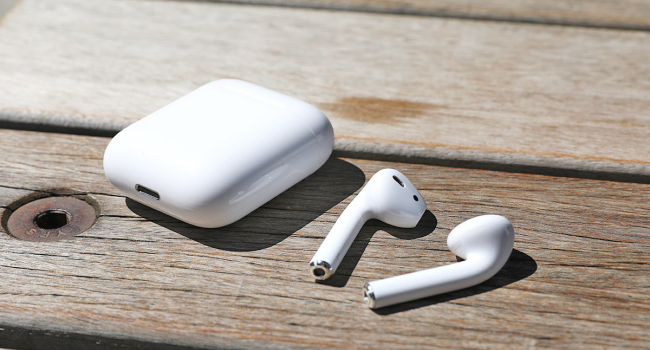
Apple brings the future closer: AirPods may become a window into the brain thanks to PARS technology
Apple is taking a new step in merging technology with health by developing a system that could turn AirPods into a device capable of reading brain signals. The project’s internal code name is PARS (PAirwise Relative Shift). This innovation, based on self-supervised artificial intelligence, promises to transform the way electroencephalograms (EEG) are analyzed, making the process simpler, cheaper, and more accessible. This was reported by ITHome, citing a recent Apple study and 2023 patent documentation.
PARS: how AI learns to understand the brain without guidance
Traditional EEG analysis methods require neurologists to manually label data, specifying which parts of the signal correspond to sleep stages (REM, non-REM), epileptic events, or motor activity. This is a labor-intensive and expensive process that limits large-scale adoption. PARS changes the rules: instead of labeled data, the AI trains itself on raw, unannotated signals, predicting time intervals between random segments of brain waves.
This approach allows the algorithm to capture not only local patterns but also long-term dependencies in neural activity, such as transitions between sleep phases. In tests on four benchmark datasets, including sleep monitoring, epilepsy, and motor activity, PARS matched or outperformed the best existing methods in three of them. This demonstrates the technology’s potential for clinical use without the need for expensive laboratories.
Ear-EEG: brain waves through the ear
A key part of the study is the use of the EESM17 dataset collected with in-ear EEG systems. Unlike traditional EEG caps with electrodes placed on the scalp, ear-EEG positions sensors inside or around the ear canal. Although these signals are weaker and noisier, they still capture clinically meaningful patterns such as sleep stages, epileptic markers, and even motor commands.
Apple tested ear-EEG on sleep recordings from nine volunteers using a 12-channel ear system and a 6-channel scalp reference system. The results confirmed that in-ear sensors can form the basis of compact and unobtrusive devices like AirPods without significant loss in accuracy.
Technical implementation: how AirPods will read the brain
Apple’s 2023 patent describes how this could work. Multiple active and reference electrodes would be placed on the AirPods housing and ear tips. These electrodes would measure not only EEG but also other biosignals, such as electromyography (EMG), electrooculography (EOG), electrocardiography (ECG), and even galvanic skin response. The unique anatomy of each person’s ear poses a challenge for stable electrode contact, but Apple addresses this through AI that dynamically selects the optimal electrode pairs in real time to ensure the best possible signal.
The user will be able to initiate measurements with a simple tap on the earbud, and built-in optical sensors will enable gesture control. This makes the technology intuitive and ready for mass-market use.
Why Apple needs this and what comes next
Apple’s interest in medical devices is not new. Apple Watch already measures ECG, blood oxygen levels, and detects arrhythmias. AirPods with EEG capabilities fit perfectly into this strategy, offering the potential for:
- Health monitoring: diagnosing sleep disorders, early detection of epilepsy or cognitive conditions.
• Mental well-being: meditation and stress-management apps with real-time feedback.
• Brain computer interfaces: controlling devices through thought, enabling new opportunities for people with limited mobility.
• Games and entertainment: controlling music or games through visualization.
However, the path to a consumer product is challenging. Apart from technical issues (noise, energy consumption), there are serious privacy and regulatory considerations. Europe’s strict GDPR rules may require strong data protection guarantees. In the United States, the FDA has approved ECG functions in Apple Watch, but EEG falls under a more complex category that requires clinical trials.
In short
Apple has developed the PARS technology that enables AI to analyze brain waves without manual data labeling and has tested it on ear-EEG systems that could be integrated into future AirPods. A 2023 patent describes earbuds equipped with electrodes that automatically adapt to individual ear shapes. The technology promises a breakthrough in sleep monitoring, epilepsy detection, and brain computer interfaces, but real products are still far off due to regulatory and ethical barriers. Apple once again shows how quickly the line between science fiction and reality is disappearing.
- Related News
- Can you swim in the sea with a smartwatch?
- Smart gadgets 2026: Five devices that truly make life easier
- What gadgets is Apple preparing for 2027?
- Apple is holding back several key iOS 27 features for the fall presentation
- Apple is preparing a successor to AirPods: Its first smart glasses are expected to arrive in 2027
- Google unveils the screen-free Fitbit Air Fitness Band
- Tech Jobs
- Most read
month
week
day
- Two comets will be visible in Autumn 2026 1259
- DeepSeek or ChatGPT: Which is better in 2026? 1039
- NASA successfully launches Nancy Grace Roman space telescope – "Hubble's successor" 666
- Anthropic teaches AI to control real-world machines 650
- New Apple CEO to refresh top management team: What we know 634
- Scientists have learned to transmit data by laser through atmospheric disturbances 623
- Cosmonaut Harutyun Kiviryan passes pre-flight exam on ISS simulator 623
- Beijing opens "Kindergarten" for robots: Machines learn from their own mistakes 603
- What will happen to the human body on Mars? 588
- Dark matter detector captures the weakest neutrinos ever detected 550
- Archive