


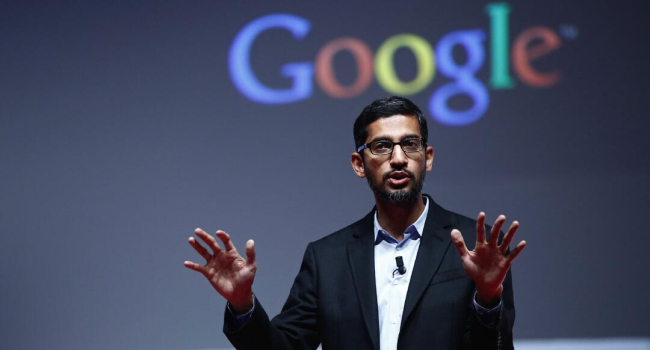
Google’s CEO urges users not to trust AI answers blindly and to always verify information
Google and Alphabet CEO Sundar Pichai, in an interview with the BBC, explicitly urged users to treat answers from neural networks critically and to always verify the information they receive. He said that even the most advanced artificial intelligence models still make mistakes, and that people should not rely on them blindly.
Pichai emphasized that AI is a powerful tool but remains imperfect. He noted that people should be taught to use it where it is genuinely helpful and not to take every output at face value.
His remarks came in response to a BBC investigation showing that popular chatbots often distort facts when retelling news, add details that do not exist, or present false information as accurate.
A Possible AI “Bubble”
Pichai also admitted that the current surge in AI investments reminds him of the dot-com bubble of the late 1990s and early 2000s. In his view, the market has become partly irrational: enormous sums are being poured in, while real returns still lag behind expectations.
He added that if the bubble were to burst, it would affect all major players, including Google itself. At the same time, he stressed that the technology remains fundamentally important, much like the internet once did.
Google Will Train AI Models in the United Kingdom
On a more positive note, Pichai said that the company plans to begin training its large language models in the United Kingdom in the near future. This move will strengthen the UK’s position as one of the world’s key centers for AI development alongside the United States and China.
In Short
Sundar Pichai made a straightforward warning: neural networks still make frequent mistakes, and their answers must be verified. The current AI hype resembles the dot-com bubble and may end in a painful correction affecting everyone. Yet the technology itself is here to stay — and Google is already preparing to advance it, including on new sites such as the UK.
- Related News
- 50,000 subscriptions and AI for schools: How Armenia plans to use artificial intelligence in education
- How to work with neural networks properly: 5 rules that actually help
- Why Bill Gates is no longer an AI optimist: Three major threats of AI
- Firebird AI Joins UATE as a Strategic Member
- Neural networks can't read minds: 4 key rules for working effectively with AI
- OpenAI prepares to go public in 2027
- Tech Jobs
- Most read
month
week
day
- Top tablets of August 2026: Experts name the best five 982
- Top flagships of August 2026: Experts name the five best smartphones 865
- From Excel to AI: A startup by specialists who relocated from Iran to Armenia helps businesses make sense of their data 853
- The anniversary iPhone 20 will be as thin as the Air: what the insider revealed 711
- Why Bill Gates is no longer an AI optimist: Three major threats of AI 648
- Robot knocks out teeth of five year old girl: Incident at Chinese museum leads to lengthy compensation dispute 596
- How NASA's primary training centre is changing in the era of commercial space stations 591
- 10,000 tiny probes to Saturn's rings and robots in lunar caves: NASA funds 18 visionary ideas 584
- Apple prepares to raise iPhone prices following Samsung and Google 555
- 20 years without planet status: Will Pluto get its title back? 506
- Archive