


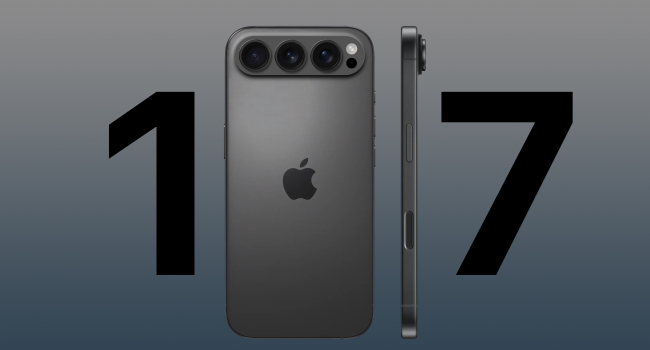
Which iPhone 17 to buy in 2025–2026: A guide to the new models
The iPhone 17 lineup has become one of the most diverse in recent years: it includes the long-awaited 120 Hz display in the base model, the ultra-thin Air, and the controversial return to aluminum in the Pro versions. We tested all four smartphones and can now explain which model is perfect for which user and where it is better not to overpay.
iPhone 17 — The Golden Mean Without Compromises
This year, for the first time in many years, the base iPhone can truly be described as universal.
• 6.3-inch OLED with ProMotion 120 Hz and Always-On Display
• Dual camera 48 + 48 MP (main + ultrawide)
• New A19 chip with a 5-core GPU
• 18 MP front camera
• Weight of only 177 g
Apple’s main achievement is that the base model no longer has the usual shortcomings. The screen is finally smooth, the cameras perform at the level of last year’s Pro models, and battery life has risen to a comfortable 6–7 hours of screen time.
Who it suits: almost everyone. If you do not shoot professional video, do not need optical zoom, and do not play AAA games at max settings, the iPhone 17 will handle all your tasks while saving you money.
iPhone Air — The Thinnest and Lightest in Apple’s History
At 5.6 mm thick and 165 g, this device feels almost weightless in the hand.
• Titanium and glass body
• A19 Pro chip (slightly more powerful than the base version)
• 12 GB of RAM
• Single 48 MP rear camera + 18 MP front
• 6.5-inch 120 Hz OLED
There are compromises: only one rear camera, a single speaker, USB-C without video output, and a slightly protruding camera bump. Yet the battery life is surprisingly good — a full day with moderate use.
Who it suits: those tired of bulky phones and willing to trade part of the camera experience for exceptional ergonomics and a wow-effect.
iPhone 17 Pro — Power in a Compact Body (With Caveats)
The smaller Pro version introduces one of the most divisive designs in recent years:
• Return to an aluminum frame instead of titanium
• A huge camera plateau covering nearly half the back
• Triple 48 + 48 + 48 MP system with a new telephoto lens
• A19 Pro with a 6-core GPU and vapor-chamber cooling
The advantages are clear: one of the best mobile camera systems available, support for ProRAW and ProRes, and stable 120 fps in demanding games such as Genshin Impact and Resident Evil. The disadvantages are also obvious: aluminum scratches and dents more easily than titanium, and the bright colors (especially blue and orange) tend to fade unevenly, eventually creating a patchy effect after a couple of months.
Who it suits: photographers, videographers, and gamers who need maximum performance in a standard-sized phone and who plan to use a case immediately.
iPhone 17 Pro Max — The King of Battery Life and Large Screens
This is everything the regular Pro offers, but with the Max prefix:
• 6.9-inch display
• The largest battery in iPhone history (up to two days of use)
• A version with up to 2 TB of storage
If you watch movies, edit videos on your device, or simply love large screens, this is the right choice. The drawbacks remain the same: aluminum and the uneven fading of bright color options.
In Short: Which iPhone 17 You Should Buy
• Universal smartphone without overpaying → iPhone 17
• The thinnest and lightest model → iPhone Air
• Best cameras and gaming in a compact body → iPhone 17 Pro (but use a case)
• Maximum screen and battery life → iPhone 17 Pro Max
In 2025, Apple has for the first time made the base model feel complete rather than limited. Whichever version you choose, you receive a smooth 120 Hz screen, MagSafe, long iOS support, and relevance through at least 2030. The key is to answer one question honestly: what matters most to you — perfect photos, minimal weight, or simply a device that handles everything? That answer will point to your ideal iPhone 17.
- Related News
- Blue light from screens: Is it really dangerous for eyes, and what should you know?
- Top flagships of August 2026: Experts name the five best smartphones
- A simple way to spend less time on your phone: Choosing your own goals?
- Foldable iPhone appeals to almost no one: Three-quarters of Americans don't want one
- The anniversary iPhone 20 will be as thin as the Air: what the insider revealed
- Apple prepares to raise iPhone prices following Samsung and Google
- Tech Jobs
- Most read
month
week
day
- Two comets will be visible in Autumn 2026 1262
- DeepSeek or ChatGPT: Which is better in 2026? 1042
- NASA successfully launches Nancy Grace Roman space telescope – "Hubble's successor" 666
- Anthropic teaches AI to control real-world machines 650
- New Apple CEO to refresh top management team: What we know 636
- Scientists have learned to transmit data by laser through atmospheric disturbances 624
- Cosmonaut Harutyun Kiviryan passes pre-flight exam on ISS simulator 624
- Beijing opens "Kindergarten" for robots: Machines learn from their own mistakes 604
- What will happen to the human body on Mars? 589
- Dark matter detector captures the weakest neutrinos ever detected 553
- Archive