


A 4-billion-person divide: Microsoft’s report on global AI adoption
Microsoft has released an extensive AI Diffusion Report 2025 — a 90-slide analysis based on a survey of 3,000 leaders and specialists from 11 countries. The findings are shocking: AI is spreading faster than any technology in history, reaching 1.2 billion users in three years, yet nearly half of the world — 4 billion people — lacks the basic infrastructure to use it. This is not only a humanitarian crisis but also an economic time bomb.
While Meta spends billions on AI infrastructure, Reddit prepares for lawsuits over data, and Google blocks 10 billion fraudulent schemes monthly, the global AI access gap is deepening.
Let’s look at the report’s key findings and their implications.
A Digital Canyon 4 Billion People Deep
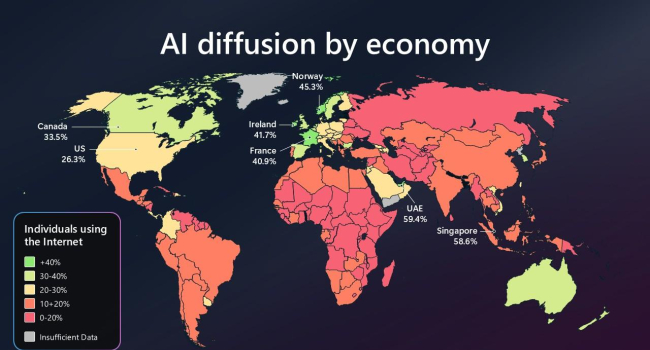
AI is the fastest-adopted technology in history — faster than electricity or the internet. But according to Microsoft, 47% of the world’s population (4 billion people) lacks electricity, stable internet, or digital skills. In countries like the UAE and Singapore, 58–59% of the working population uses AI; in Norway, 52%. In Sub-Saharan Africa, less than 10%. In Armenia, according to the report, the penetration of AI is only 6.2%.
The report stresses that this is not the periphery but the foundation of the market. Without infrastructure, AI becomes an elite tool for the “global north,” where the U.S. and China control 86% of data centers, leaving the remaining 14% as “scraps” for the rest of the world.
An economic example: in 1960, the Philippines and South Korea had equal GDP per capita. Korea invested in digitalization — achieving 6.2% annual growth and leadership in chips. The Philippines grew at 1.8%, remaining dependent on outsourcing. AI may repeat this pattern globally: countries with infrastructure (the U.S., China, France, South Korea, the U.K., Canada, Israel — only seven host frontier models) will pull far ahead.
Three Forces Driving AI Diffusion
Microsoft identifies three “forces of diffusion”:
Frontier Builders: OpenAI, Google, Anthropic — the model creators. They are concentrated in seven countries; the entire Global South is excluded.
Infrastructure Builders: They scale through data centers. The U.S. and China hold 86% of global capacity; the rest of the world competes for leftovers.
Users: They adopt and adapt AI. In the UAE — 59%; in Africa — 10%. Latent demand is huge: in low-income countries with internet access, adoption rates are 20% lower due to language barriers (half of AI content is in English, though only 5% of the world are native speakers).
The language problem: of the world’s 7,000 languages, AI is trained mostly on “high-resource” ones (English, Chinese). “Low-resource” languages (Hausa, Bengali, Chichewa) are used 20% less often, even when GDP and connectivity are similar.
Consequences for Business and Society
For corporate leaders, the report is a wake-up call:
The talent war: Singapore, with 59% AI adoption, has become a magnet for specialists. Companies now compete not only with each other but with entire countries that invested in digital infrastructure decades ago.
The market is smaller than it looks: 750 million people lack electricity — 85% of this deficit is in Africa. AI products for the “global market”? Forget half your audience.
Infrastructure arbitrage: Once it was cheap labor; now it’s data centers. Countries like India and Brazil that build capacity will become AI outsourcing hubs.
ESG factor: Boards will start asking about “AI equality.” Smart firms are already investing in edge computing, offline AI, and models for low-end hardware.
Additional Insights: Only 8% of companies see true transformation from AI — the rest are stuck in “pilot hell.” The main barrier is fragmented initiatives: everyone builds “sandboxes,” no one builds a “platform.” High-performing organizations focus on training, ethics, and integration — not just on vendors.
Parallels: Meta, Reddit, and Google in 2025
Microsoft’s report doesn’t exist in a vacuum. Meta is spending $66–72 billion on AI infrastructure in 2025 (a 70% year-over-year increase), focusing on data centers and GPUs. CEO Mark Zuckerberg calls it “a competitive edge for models and products.” But investors are nervous — there’s still no monetization.
Reddit heads to court: in October 2025, it filed a lawsuit against Perplexity, Oxylabs, AWMProxy, and SerpApi for data scraping for AI (3 billion Google searches). Reddit is a top source for AI answers but without licensing. A similar lawsuit was filed against Anthropic in June. CEO Steve Huffman says, “We understand both sides,” but defends Reddit’s content (licensing deals with OpenAI and Google are worth $60 million).
Google fights fraud: AI in Messages and Phone blocks 2 billion suspicious messages per month (a 20× increase). In 2025, it added detection for crypto scams, fake investments, and tech support fraud. All on-device for privacy; currently in the U.S., U.K., and Canada in English, with global expansion planned.
In Short…
Microsoft’s AI Diffusion Report 2025 shows AI as the fastest-spreading technology (1.2 billion users), but 4 billion people remain without infrastructure — a “digital canyon.” Three forces drive the divide: frontier (7 countries), infrastructure (U.S. + China 86%), users (UAE 59%, Africa <10%). The language gap is massive (7,000 languages, half of AI content in English). For business: talent wars, shrinking markets, and ESG risks. Meta spends $70 billion on AI, Reddit sues over data, Google blocks 2 billion scam messages monthly. Without investment in the Global South, AI will deepen inequality — time to act.
- Related News
- 50,000 subscriptions and AI for schools: How Armenia plans to use artificial intelligence in education
- How to work with neural networks properly: 5 rules that actually help
- Why Bill Gates is no longer an AI optimist: Three major threats of AI
- Firebird AI Joins UATE as a Strategic Member
- Neural networks can't read minds: 4 key rules for working effectively with AI
- OpenAI prepares to go public in 2027
- Tech Jobs
- Most read
month
week
day
- From Excel to AI: A startup by specialists who relocated from Iran to Armenia helps businesses make sense of their data 634
- The anniversary iPhone 20 will be as thin as the Air: what the insider revealed 616
- How NASA's primary training centre is changing in the era of commercial space stations 574
- Top flagships of August 2026: Experts name the five best smartphones 562
- Why Bill Gates is no longer an AI optimist: Three major threats of AI 547
- Robot knocks out teeth of five year old girl: Incident at Chinese museum leads to lengthy compensation dispute 542
- 10,000 tiny probes to Saturn's rings and robots in lunar caves: NASA funds 18 visionary ideas 485
- How to make your new smartphone more secure: expert tips 475
- Apple prepares to raise iPhone prices following Samsung and Google 465
- "Dark photons" back in play: scientists revise constraints on dark matter 461
- Archive