


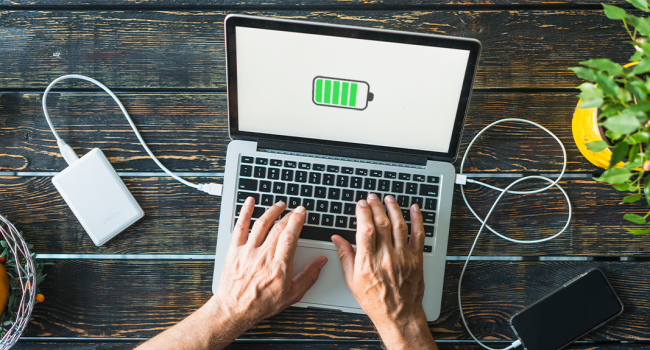
How to extend battery life in smartphones and laptops: Scientists share key tips
The batteries in today’s gadgets — lithium-ion and lithium-polymer — tend to “age” quickly when used improperly. Devices gradually lose capacity, forcing users to recharge more often. Experts from Perm Polytechnic University (PNRPU) have shared proven methods to slow down battery wear, according to Gazeta.Ru, citing the university’s press service.
Smartphones vs. Laptops: Different Systems, Same Problems
Although both types of devices use similar batteries, their charging management systems differ significantly:
• Laptops feature advanced controllers that automatically stop charging once 100% is reached, reducing stress on the battery.
• Smartphones, on the other hand, have simpler controllers that do not fully protect against constant “overcharging” when left plugged in — the main cause of degradation.
“Keeping a battery at 100% all the time is like running an engine in the red zone,” explains Alexander Romodin, Ph.D., Associate Professor of Microprocessor Automation Systems at PNRPU.
The Golden Rule: 20–80%
The main recommendation for smartphones:
• Maintain charge levels between 20% and 80%.
• Avoid charging to 100% on a regular basis.
• Perform a full cycle (from 10–15% to 100%) once or twice a month — this helps calibrate the system that estimates battery capacity.
What to Avoid
- Full discharge — keeping a battery at 0% for 1–2 weeks can cause irreversible degradation.
- Overheating above 40°C (104°F) — accelerates internal chemical reactions.
- Charging below 10°C (50°F) — can cause internal damage.
You can monitor temperature in settings or via apps such as AIDA64 or CPU-Z. If the device feels hot, let it cool before charging.
Use Only Original Chargers
“Uncertified chargers often deliver unstable current and voltage, which leads directly to premature wear,” warns Daniil Kurushin, Associate Professor of Information Technologies and Automated Systems at PNRPU.
Laptop-Specific Advice
- When working plugged in, keep charge between 50% and 80%.
• Enable charging limit modes (available on Lenovo, Dell, ASUS, HP, and others) — these automatically stop charging at a set level, typically 60–80%.
Practical Life Hacks
|
Action |
Effect |
|
Remove the case while charging |
Reduces heat buildup |
|
Avoid playing heavy games while charging |
Prevents peak loads |
|
Turn off Bluetooth/Wi-Fi when idle |
Reduces background drain |
|
Enable airplane mode at night |
Minimizes energy consumption |
In Brief
Keep your charge between 20–80%, avoid overheating and deep discharge, and use original chargers. For laptops, enable charge-limiting modes. Do one full charge cycle per month for calibration.
Following these simple rules can extend your battery’s lifespan by 1–2 years.
- Related News
- Top flagships of August 2026: Experts name the five best smartphones
- A simple way to spend less time on your phone: Choosing your own goals?
- Foldable iPhone appeals to almost no one: Three-quarters of Americans don't want one
- The anniversary iPhone 20 will be as thin as the Air: what the insider revealed
- Apple prepares to raise iPhone prices following Samsung and Google
- What you must do before disposing of or selling your smartphone: useful tips
- Tech Jobs
- Most read
month
week
day
- Top tablets of August 2026: Experts name the best five 1474
- Top flagships of August 2026: Experts name the five best smartphones 1192
- From Excel to AI: A startup by specialists who relocated from Iran to Armenia helps businesses make sense of their data 1072
- The anniversary iPhone 20 will be as thin as the Air: what the insider revealed 815
- Why Bill Gates is no longer an AI optimist: Three major threats of AI 762
- 50,000 subscriptions and AI for schools: How Armenia plans to use artificial intelligence in education 687
- 10,000 tiny probes to Saturn's rings and robots in lunar caves: NASA funds 18 visionary ideas 672
- Robot knocks out teeth of five year old girl: Incident at Chinese museum leads to lengthy compensation dispute 658
- Apple prepares to raise iPhone prices following Samsung and Google 634
- The Roman space telescope will reveal the Universe as Hubble and JWST cannot 593
- Archive