


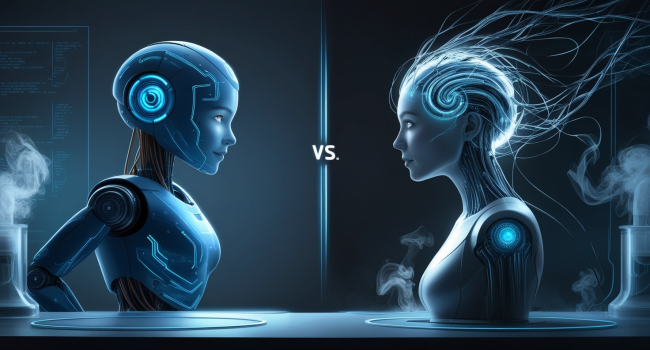
AI vs. AI: The battle of autonomous systems
Once a mere tool, AI is now becoming a player in its own right. In 2025, neural networks are increasingly clashing with one another. One AI generates text—another filters it. One pushes ads—another bypasses them. One optimizes sales—another is trained to “outsmart” that algorithm. In this race, humans are often less the subject and more a side effect in a grand battle for attention.
Advertising as a Battlefield
Every second, Google Ads and Meta conduct millions of auctions for your attention. Their AI systems decide whether to show you an ad for a new smartphone or sneakers. But cunning players—AI optimizers—have entered the fray. Companies like AdCreative.ai create banners and texts designed to slip past platform algorithms and land in your feed. In 2024, Google bolstered its Smart Bidding, but the race continues.
According to eMarketer, in 2025, 85% of online advertising is managed by AI. It’s an invisible auction where the stakes are fractions of a second of your attention. While algorithms battle it out, all you see is a flashy banner, unaware of the technological showdown behind it.
When AIs compete for our attention, we risk becoming hostages to algorithms that optimize not for our interests but for their own metrics, says Tristan Harris, co-founder of the Center for Humane Technology.
Bots Storm the Feed: Who’s Writing Your News?
Open X and see a post about a sensational discovery or a hot sale. But who wrote it? A human or a bot? MIT estimates that in 2025, up to 30% of social media content is generated by AI. As early as 2023, bots powered by models like Grok or LLaMA flooded X with posts promoting everything from cryptocurrencies to fake news.
Countering them are AI moderators. Platforms like X deploy algorithms to combat spam, but bots are learning to evade filters using adversarial learning—strategies that confuse other algorithms. This is no longer just a fight for information; it’s a clash of systems. You, meanwhile, see only a “recommended” post, unaware it’s a survivor of a digital skirmish.
We’re witnessing an evolution of AI where systems learn to deceive each other, creating complex challenges for digital platforms. This is not just a technical issue but a question of trust. If we’re not careful, this dynamic could undermine users’ confidence in technology, says Stanford University professor Fei-Fei Li in an interview with The Guardian.
Interfaces for Machines: Why Websites Are Less User-Friendly
Have you noticed that online store websites are becoming less intuitive? “Buy Now” buttons scream for attention, headlines are stuffed with keywords, and product suggestions seem misaligned with your interests. This is partly because interfaces are increasingly tailored to ranking and recommendation algorithms like Google Search or Amazon’s A9.
Optimizing for these systems drives more clicks and sales for businesses, often at the expense of user experience. Additionally, AI algorithms process data faster when page structures are simplified, which can compromise usability. Shopify stores, YouTube channels, and TikTok content are increasingly designed with algorithms, not users, in mind.
Now imagine these algorithms interacting not just with you but with other AIs. TikTok and YouTube are already adapting recommendations not only for humans but also for AI assistants that “watch” and analyze content. This creates “information bubbles” where everything you see is the result of a chain of algorithms working together.
How to Stay Grounded in This Race
The battle between AIs leaves its mark on daily life: from fake news and manipulative ads to interfaces that are hard to navigate. This is no longer just a story about technology—it’s about the human factor and trust.
Yet there’s a counter-movement. The future doesn’t have to mean a war of machines. Perhaps the real challenge is learning to build technologies where humans regain their role as participants, not mere observers.
- Related News
- Beijing opens "Kindergarten" for robots: Machines learn from their own mistakes
- Anthropic teaches AI to control real-world machines
- DeepSeek or ChatGPT: Which is better in 2026?
- What Claude can do: A complete overview of one of the most popular AI assistants
- 50,000 subscriptions and AI for schools: How Armenia plans to use artificial intelligence in education
- How to work with neural networks properly: 5 rules that actually help
- Tech Jobs
- Most read
month
week
day
- Two comets will be visible in Autumn 2026 1255
- DeepSeek or ChatGPT: Which is better in 2026? 1033
- NASA successfully launches Nancy Grace Roman space telescope – "Hubble's successor" 666
- Anthropic teaches AI to control real-world machines 650
- New Apple CEO to refresh top management team: What we know 634
- Scientists have learned to transmit data by laser through atmospheric disturbances 621
- Cosmonaut Harutyun Kiviryan passes pre-flight exam on ISS simulator 621
- Beijing opens "Kindergarten" for robots: Machines learn from their own mistakes 601
- What will happen to the human body on Mars? 586
- Dark matter detector captures the weakest neutrinos ever detected 547
- Archive