


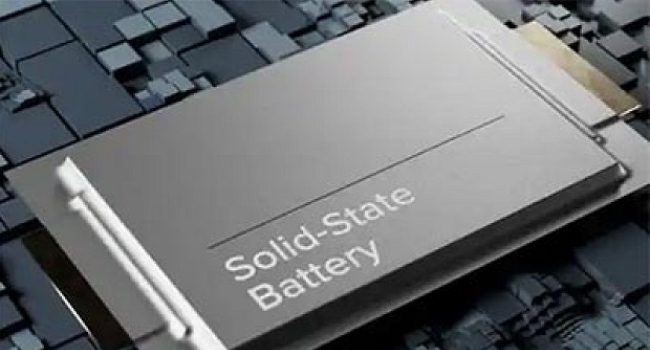
New superionic material could help create more efficient batteries
Researchers from Duke University have studied the mechanism of fast ion mobility in the superionic compound Li₆PS₅Cl. They found that the ions in this material behave like a liquid, which could significantly improve the efficiency of solid-state batteries. The work was published in the journal Nature Physics.
What are superionic materials?
Superionic compounds have unique properties: in their structure, some ions remain in place, while others move freely, as in a liquid. This makes them promising electrolytes for solid-state batteries, which in the future could replace traditional lithium-ion batteries.
Unlike batteries with liquid electrolytes, solid-state batteries provide increased safety, greater durability, and high energy capacity. However, the mechanisms of ultra-fast ion movement in such materials are still poorly understood.
Research on lithium argyrodite
Scientists focused on the compound Li₆PS₅Cl, one of the most promising solid-state electrolytes.
The main question of the research: do the lithium ions in this material move like ordinary atomic vibrations or do they behave more like a liquid?
To find out, the team used:
- Neutron scattering to study atomic vibrations over a wide frequency range (from gigahertz to terahertz).
- Computer modeling using machine learning methods to analyze the interaction of lithium ions with the crystal lattice.
The calculations were carried out on high-performance computing systems, which allowed us to obtain a detailed picture of the ion motion.
Main discoveries
Transition to a liquid-like state:
- As the temperature increases, lithium ions change their behavior, becoming more mobile.
- Spectral analysis showed that their dynamics gradually transition from crystalline to liquid-like.
The reason for high conductivity:
- Previously, it was believed that ionic mobility is determined by vibrations of the crystal lattice.
- New data show that liquid-like effects play a key role.
What does this mean for batteries?
Improving Solid-State Batteries
New knowledge will help develop materials with high ionic conductivity and stability.
Applications in other technologies
Superionic materials are promising not only for batteries, but also for fuel cells, sensors and processors.
“Superionic materials have complex dynamics, and their design remains a challenge,” said Olivier Delaire, lead author of the study.
The results of the work pave the way for the development of new generations of energy-dense and safe batteries that could revolutionize the energy storage market.
- Related News
- Samsung unveils monitor with record-breaking 1100 Hz refresh rate
- How to recover a corrupted USB flash drive: A practical guide
- Memory shortage hits the budget market: Why are smartphones under $100 disappearing from the market?
- Expert explains why smartphone storage quietly fills up
- How much RAM do you really need for gaming in 2026
- A full-fledged DLSS equivalent is coming to smartphones
- Tech Jobs
- Most read
month
week
day
- Two comets will be visible in Autumn 2026 1255
- DeepSeek or ChatGPT: Which is better in 2026? 1033
- NASA successfully launches Nancy Grace Roman space telescope – "Hubble's successor" 666
- Anthropic teaches AI to control real-world machines 650
- New Apple CEO to refresh top management team: What we know 634
- Scientists have learned to transmit data by laser through atmospheric disturbances 621
- Cosmonaut Harutyun Kiviryan passes pre-flight exam on ISS simulator 621
- Beijing opens "Kindergarten" for robots: Machines learn from their own mistakes 601
- What will happen to the human body on Mars? 586
- Dark matter detector captures the weakest neutrinos ever detected 547
- Archive