


X-rays taken in space for the first time: Why this could save astronauts' lives on the Moon
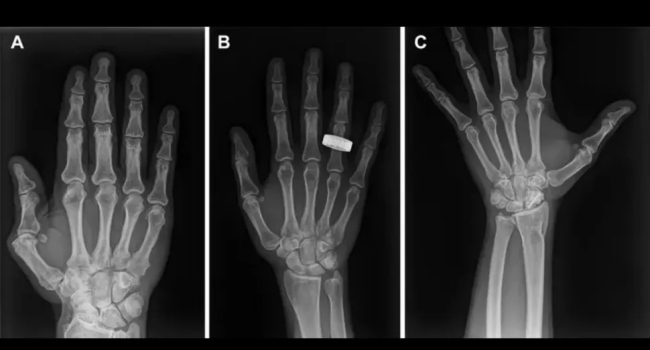
For the first time in human history, full-fledged X-ray images have been taken aboard a spacecraft. The experiment, conducted during the private Fram2 mission in March 2025, opens up new possibilities for medical diagnostics in space, reports Space.com.
How the experiment went
Four first-time astronauts, who had only four hours of training, successfully took X-ray images of their wrists, abdomen, pelvis, chest, and even smartwatches in orbit. A portable X-ray machine was used for this purpose. The images were recorded in digital format, allowing immediate assessment of their quality.
Comparison with ground-based images showed that the quality of the space images was somewhat lower, but quite sufficient for diagnosing fractures and other injuries.
Why this matters
Until now, only ultrasound devices had been used for medical diagnostics in space. X-ray images are significantly more informative, especially when fractures or internal injuries are suspected. With the development of the Artemis program and plans to establish a permanent base on the Moon, the risk of injuries to astronauts increases, and the ability to conduct rapid diagnostics becomes critically important.
Shayna Gifford, a physician and associate professor of aerospace medicine at the Mayo Clinic, noted that they believed the portable system would withstand pre-launch tests and function in space with minimal crew training.
Applications of the technology
X-ray machines in space could be used not only for diagnosing astronauts' health. They could help check the condition of electronics, spacesuits, and equipment. In the future, such devices could be mounted on lunar rovers for surface analysis.
Furthermore, portable X-ray systems could revolutionize medicine on Earth. They would be particularly useful in remote areas, disaster zones, and for rescue teams where access to large hospitals is unavailable.
What's next
The next step is to make the devices even more compact, robust, and user-friendly. Scientists hope such devices will become standard equipment for future lunar missions.
In brief
During the private Fram2 mission in 2025, astronauts took X-ray images in space for the first time in history. A portable device successfully passed the tests and demonstrated sufficient quality for diagnosing injuries. This discovery is important for future Artemis lunar missions, where the risk of injury increases. The technology could also significantly improve medical care in hard-to-reach areas on Earth. The results were published in the journal Radiology.
- Related News
- BepiColombo begins arrival at Mercury after nearly eight years of flight
- Astrophysicist connects modern science with the traditions of South Africa's indigenous peoples
- Rogue Planets: Lonely worlds wandering through the Galaxy
- MIT study: building blocks of life could survive in the acid clouds of Venus
- Cosmonaut Harutyun Kiviryan passes pre-flight exam on ISS simulator
- First ocean-bearing planets may have emerged almost immediately after the Big Bang
- Tech Jobs
- Most read
month
week
day
- Top tablets of August 2026: Experts name the best five 1799
- Two comets will be visible in Autumn 2026 987
- DeepSeek or ChatGPT: Which is better in 2026? 694
- Anthropic teaches AI to control real-world machines 613
- NASA successfully launches Nancy Grace Roman space telescope – "Hubble's successor" 610
- New Apple CEO to refresh top management team: What we know 595
- Blue light from screens: Is it really dangerous for eyes, and what should you know? 486
- Scientists have learned to transmit data by laser through atmospheric disturbances 469
- Antarctic microbes survived in open space 454
- Why does time speed up, and can it be slowed down? 450
- Archive