


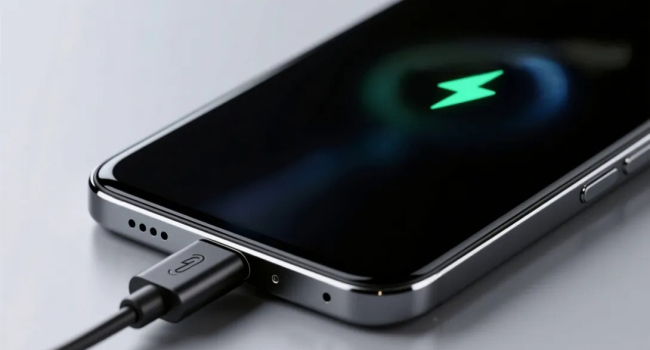
Why fast charging accelerates battery wear in smartphones and laptops
Fast charging technologies significantly reduce the time needed to replenish energy, but at the same time noticeably accelerate battery degradation. This is the conclusion reached by specialists who studied the processes occurring inside lithium-ion batteries.
How fast charging works
Lithium-ion batteries operate through the movement of lithium ions between the cathode and anode. During normal charging, this process occurs gradually and evenly. However, when using fast charging, the increased current forces ions to move much faster. This creates additional stress on the electrodes and can cause irreversible damage.
Main causes of accelerated wear
One of the main problems is the formation of lithium plating on the anode. At high charging speeds, lithium ions do not have time to fully integrate into the anode's structure and begin to deposit on its surface. Over time, this reduces the battery's effective capacity. In severe cases, so-called dendrites — needle-like structures that can damage internal components and even cause short circuits — may form.
Another serious factor is overheating. The higher the charging power, the more heat is generated inside the battery. Prolonged exposure to elevated temperatures accelerates the chemical breakdown of battery materials.
How manufacturers are addressing the problem
Modern devices are equipped with advanced battery management systems. They monitor temperature, voltage, and current, automatically reducing charging speed when approaching critical values. Special electrode materials and improved battery designs are also being used.
How to extend battery life
Experts recommend following a few simple rules:
- Use the device at a temperature of 20–25 °C
- Try to keep the charge level in the range of 20–80%
- Do not leave the laptop constantly plugged in (prolonged exposure to 100% charge accelerates degradation)
In brief
Fast charging accelerates the wear of lithium-ion batteries due to increased stress on the electrodes, lithium plating formation, and additional heating. Although manufacturers implement protection systems, moderate charging and maintaining the charge level within the 20–80% range are considered optimal for long battery life. The work was published in a specialized scientific journal.
- Related News
- Top flagships of August 2026: Experts name the five best smartphones
- A simple way to spend less time on your phone: Choosing your own goals?
- Foldable iPhone appeals to almost no one: Three-quarters of Americans don't want one
- The anniversary iPhone 20 will be as thin as the Air: what the insider revealed
- Apple prepares to raise iPhone prices following Samsung and Google
- What you must do before disposing of or selling your smartphone: useful tips
- Tech Jobs
- Most read
month
week
day
- Top tablets of August 2026: Experts name the best five 1374
- Top flagships of August 2026: Experts name the five best smartphones 1118
- From Excel to AI: A startup by specialists who relocated from Iran to Armenia helps businesses make sense of their data 1011
- The anniversary iPhone 20 will be as thin as the Air: what the insider revealed 790
- Why Bill Gates is no longer an AI optimist: Three major threats of AI 734
- 10,000 tiny probes to Saturn's rings and robots in lunar caves: NASA funds 18 visionary ideas 658
- 50,000 subscriptions and AI for schools: How Armenia plans to use artificial intelligence in education 643
- Robot knocks out teeth of five year old girl: Incident at Chinese museum leads to lengthy compensation dispute 637
- Apple prepares to raise iPhone prices following Samsung and Google 625
- How NASA's primary training centre is changing in the era of commercial space stations 614
- Archive