


Memory isn't actually as expensive as it seems? Over 70 years, DRAM prices have fallen 137 billion times
Amid the current shortage and rising memory prices, it's useful to recall just how radically the cost of data storage has changed over the past decades. Researchers from the Stanford Data Architecture & Management (DAM) project have compiled historical data showing a true revolution in DRAM pricing.
From astronomical sums to pennies
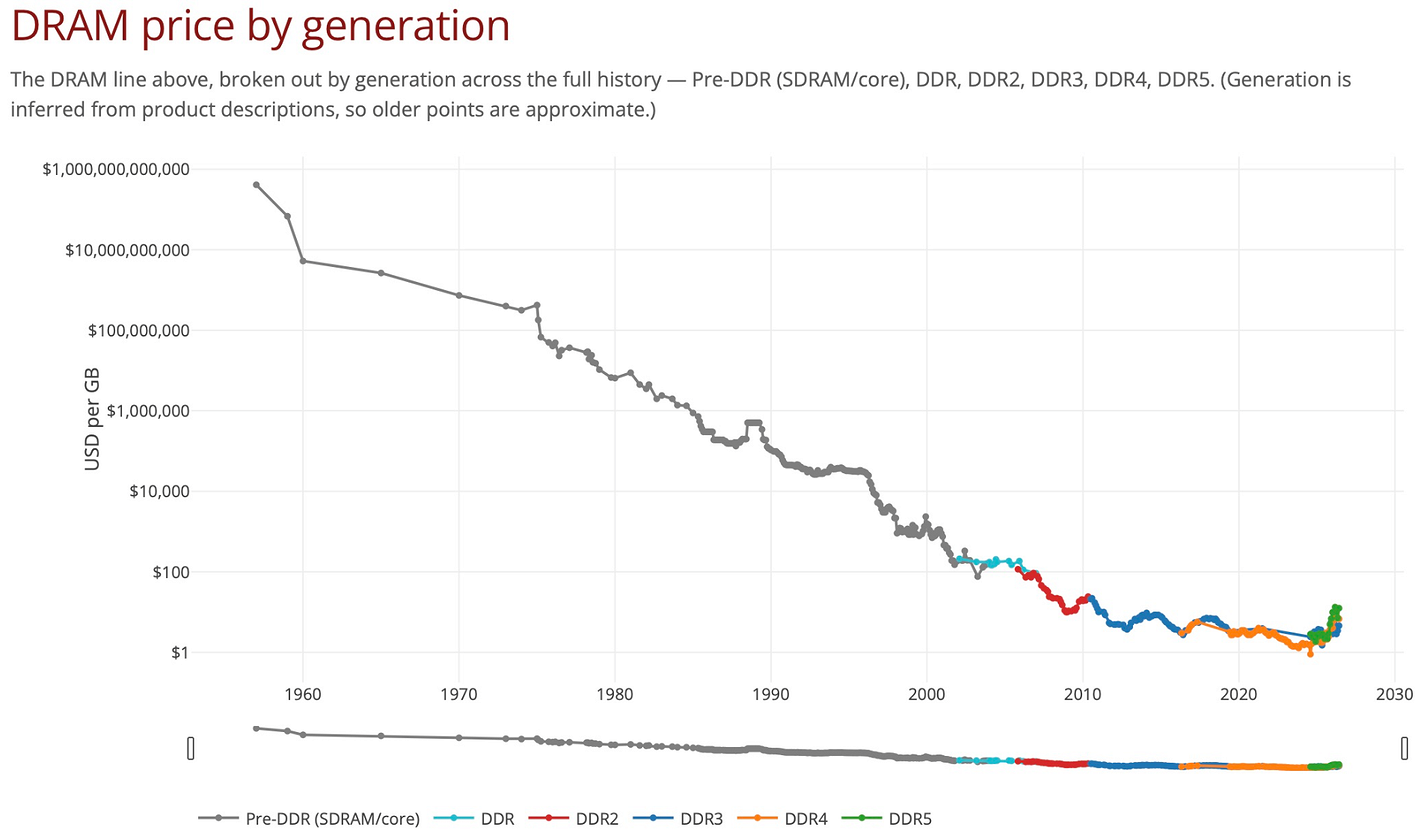
In 1957, one gigabyte of memory implemented with transistor flip-flops cost $411 billion. This was a price unaffordable even for the largest corporations and nations.
By 1960, the cost had dropped to $5.2 billion per gigabyte thanks to the advent of ferrite core memory. By 1970, the price had fallen to $180 million — still a staggering sum.
A real breakthrough came in the 1990s. Mass production and globalization drove the price down to roughly $100,000 per gigabyte. By the early 2000s, it had dropped to $1,000, and by 2010, to about $10. Today, the average cost of one gigabyte of DRAM is approximately $4.50.
Thus, over 70 years, the price of memory has collapsed by about 137 billion times.
What happened to the market
The price decline was uneven. Particularly rapid progress began in the 1990s, driven by competition among Asian manufacturers and the growth of the semiconductor industry. Production globalization and technological improvements made DRAM a mass-market and affordable product.
The researchers also note that NAND flash memory (used in SSDs) has traditionally been significantly cheaper than DRAM — typically 5–10 times less. The exception is high-performance HBM memory used in AI accelerators. Due to its complex manufacturing process and enormous demand, it costs significantly more than conventional solutions.
What this means today
Despite the current shortage and price increases caused by the AI boom, the long-term trend remains clear: the cost of data storage has been declining rapidly for decades.
Short-term crises and price spikes have occurred before, but from a historical perspective, each new gigabyte of memory becomes more affordable. This is one of the most impressive demonstrations of technological progress in human history.
In brief
Over the past 70 years, DRAM memory prices have fallen 137 billion times — from $411 billion per gigabyte in 1957 to about $4.50 today. Stanford DAM researchers have shown how technological development and production globalization have radically transformed the market. Despite the current shortage linked to the AI boom, the long-term trend of falling data storage costs continues.
- Related News
- Samsung unveils monitor with record-breaking 1100 Hz refresh rate
- How to recover a corrupted USB flash drive: A practical guide
- Memory shortage hits the budget market: Why are smartphones under $100 disappearing from the market?
- Expert explains why smartphone storage quietly fills up
- How much RAM do you really need for gaming in 2026
- A full-fledged DLSS equivalent is coming to smartphones
- Tech Jobs
- Most read
month
week
day
- Two comets will be visible in Autumn 2026 1250
- DeepSeek or ChatGPT: Which is better in 2026? 1021
- NASA successfully launches Nancy Grace Roman space telescope – "Hubble's successor" 666
- Anthropic teaches AI to control real-world machines 648
- New Apple CEO to refresh top management team: What we know 632
- Cosmonaut Harutyun Kiviryan passes pre-flight exam on ISS simulator 619
- Scientists have learned to transmit data by laser through atmospheric disturbances 618
- Beijing opens "Kindergarten" for robots: Machines learn from their own mistakes 597
- What will happen to the human body on Mars? 583
- Dark matter detector captures the weakest neutrinos ever detected 543
- Archive