


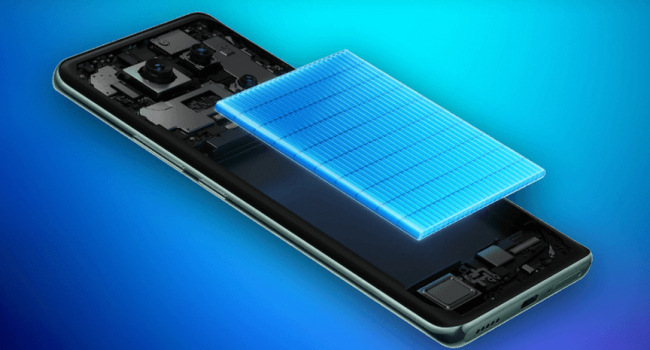
Silicon–carbon batteries in smartphones: Why 7,000–9,000 mAh has become the norm
Just a couple of years ago, a 5,000 mAh battery was considered “large”. Today, flagship smartphones easily exceed 7,000 mAh without becoming thicker. The main reason is the shift to silicon–carbon (Si-C) anodes. Here is how they work, why they are better than classic lithium-ion batteries, and whether there is any reason to worry about them.
How a silicon–carbon battery works
Fundamentally, the structure has not changed. The cathode is still aluminum-based with cobalt, nickel, and manganese, and the electrolyte remains the same. The key difference lies in the anode. Instead of pure graphite, a composite of silicon and carbon is used, typically with 5–20 percent silicon. Silicon can store up to ten times more lithium ions than graphite. Its theoretical capacity is about 4,200 mAh per gram versus 372 mAh per gram for graphite. Even with a relatively small share of silicon, this delivers a real-world capacity increase of 30–50 percent at the same physical size.
That is why in 2025 we see the following examples:
- Honor Magic7 Pro with a 7,200 mAh battery in an 8.2 mm thick корпус,
- Xiaomi 15 Ultra with a 7,500 mAh battery,
- Redmi Turbo 5 Pro, expected with a 9,000 mAh battery.
Advantages that are already noticeable
Higher capacity at the same size
The most obvious benefit is longer battery life. A smartphone can last two to three days instead of one without any increase in thickness.
Thinner and lighter designs become possible
If manufacturers keep capacity at the previous level, around 5,500–6,000 mAh, the battery occupies less space. This enables ultra-thin models such as the Vivo X200 Slim with a thickness of 6.5 mm.
Support for ultra-fast charging
Silicon binds lithium ions more effectively, so these batteries can handle 120–240 W charging without excessive heat. The Realme GT7 Pro already charges from 0 to 100 percent in 19 minutes with a 7,200 mAh battery.
Better performance in cold conditions
Graphite anodes lose their ability to accept charge sharply at –10 °C. Silicon retains about 80–90 percent of its charging speed even at –20 °C.
Potential drawbacks that are still mostly theoretical
Degradation due to silicon expansion
Pure silicon expands by up to 300 percent during charging, which can destroy the anode. Carbon shells and nanostructures reduce this expansion to a manageable 10–20 percent, but long-term durability remains a concern. Early smartphones with Si-C batteries from 2022–2023 currently show normal degradation, around 80 percent capacity after 1,000 cycles. Large-scale data will only be available in the next two to three years.
Theoretically higher fire risk
In an аварийной situation, a silicon-based battery can release more energy. However, modern protection systems such as multilayer separators and ceramic coatings keep the risk no higher than with conventional lithium-ion batteries.
Slightly higher production cost
The difference is already minimal, around 5–10 percent in battery cost, which is barely noticeable in the final price of a smartphone.
What comes next
In 2026–2027, the share of silicon in anodes is expected to rise to 30–50 percent. After that, fully silicon anodes with more advanced nanostructures will appear. This could push capacity beyond 10,000 mAh in the same volume, making week-long smartphone battery life a realistic goal.
In brief
Silicon–carbon batteries are already a reality, enabling 7,000–9,000 mAh capacities without turning smartphones into bricks. They charge faster, perform better in cold weather, and allow for thinner designs. The main drawbacks, such as potentially faster degradation and slightly higher cost, have not yet been confirmed in practice and are outweighed by the benefits. For the average user in 2025–2026, a smartphone with a Si-C battery is clearly the best choice in terms of battery life and everyday convenience.
- Related News
- Blue light from screens: Is it really dangerous for eyes, and what should you know?
- Top flagships of August 2026: Experts name the five best smartphones
- A simple way to spend less time on your phone: Choosing your own goals?
- Foldable iPhone appeals to almost no one: Three-quarters of Americans don't want one
- The anniversary iPhone 20 will be as thin as the Air: what the insider revealed
- Apple prepares to raise iPhone prices following Samsung and Google
- Tech Jobs
- Most read
month
week
day
- Two comets will be visible in Autumn 2026 1255
- DeepSeek or ChatGPT: Which is better in 2026? 1033
- NASA successfully launches Nancy Grace Roman space telescope – "Hubble's successor" 666
- Anthropic teaches AI to control real-world machines 650
- New Apple CEO to refresh top management team: What we know 634
- Scientists have learned to transmit data by laser through atmospheric disturbances 621
- Cosmonaut Harutyun Kiviryan passes pre-flight exam on ISS simulator 621
- Beijing opens "Kindergarten" for robots: Machines learn from their own mistakes 601
- What will happen to the human body on Mars? 586
- Dark matter detector captures the weakest neutrinos ever detected 547
- Archive