


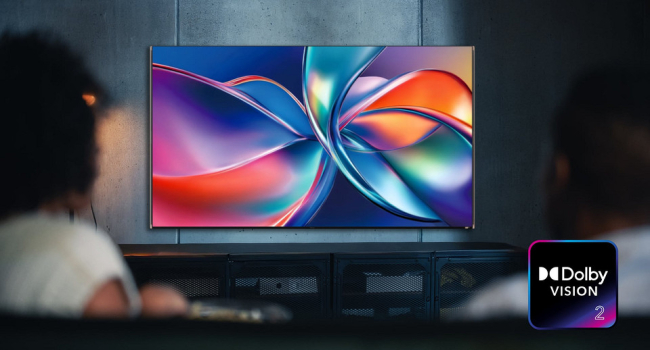
Dolby Vision 2: A new HDR standard for 2025 TVs
At the IFA 2025 exhibition in Berlin, Dolby Laboratories introduced Dolby Vision 2 — the next generation of the popular HDR standard, promising to take picture quality to a new level. This technology goes beyond traditional HDR by solving the problem of overly dark scenes and offering improved adaptation to viewing conditions. Let’s look at what makes Dolby Vision 2 unique and how it will change the way we experience content on modern TVs.
What’s New in Dolby Vision 2?
Dolby Vision 2 is based on a redesigned image engine that works together with Dolby’s extensive content ecosystem. The new standard includes several key improvements:
- Content Intelligence with AI
- Precision Black: solves the issue of dark scenes, making the picture sharp and detailed without losing artistic intent. This is especially important for films and series where details are often lost in dark moments.
- Light Sense: uses advanced ambient light sensors and data from studio content to adapt the image to room lighting.
- Optimization for sports and games: includes precise white point adjustment and motion management, ensuring smooth rendering of fast-moving scenes.
- Authentic Motion
- The world’s first motion management technology designed for content creators. It eliminates unwanted judder at the frame level while preserving the cinematic feel without the “soap opera effect.”
- Bi-Directional Tone Mapping
- Enhances brightness, contrast, and color saturation, unlocking the potential of modern TVs such as RGB-MiniLED. This gives content creators more control over how their work is displayed on screen.
“We’ve reached a point where TV technology has radically changed, and content creators demand new tools. Dolby Vision 2 redefines the standard, unlocking the full potential of modern displays and giving artists unprecedented creative possibilities,” said John Couling, Senior Vice President of Entertainment at Dolby Laboratories.
Two Levels of Dolby Vision 2
Dolby Vision 2 comes in two versions:
- Dolby Vision 2: the basic option for mass-market TVs, providing essential image quality improvements.
- Dolby Vision 2 Max: the premium version for high-performance TVs, offering additional features such as expanded tone mapping and advanced tools for enthusiasts.
This segmentation simplifies the choice of TVs with the new standard, allowing manufacturers to adapt it to different price categories.
First Partners and Compatibility
- Hisense: the first to implement Dolby Vision 2 in its premium TVs, including RGB-MiniLED models equipped with the MediaTek Pentonic 800 chip with MiraVision Pro engine. Exact release dates and models have not yet been announced.
- CANAL+: the French media company will be the first content partner, supporting Dolby Vision 2 in films, series, and sports broadcasts.
- Apple: new devices such as Apple TV 4K 2025 are expected to support Dolby Vision 2, given Apple’s close collaboration with Dolby.
Current TVs supporting Dolby Vision will remain compatible with new content, but only devices with Dolby Vision 2 will be able to use the additional metadata for enhanced playback.
Benefits for Users
Dolby Vision 2 addresses key issues of modern HDR TVs:
- Clarity in dark scenes: Precision Black makes details visible even under bright lighting.
- Environmental adaptation: Light Sense automatically adjusts brightness and contrast to room lighting.
- Cinematic motion: Authentic Motion eliminates judder while keeping scenes natural.
- Support for various content types: from movies to games and sports, the new standard optimizes visuals for each scenario.
Prospects and Expectations
The announcement of Dolby Vision 2 at IFA 2025 is just the beginning. In January 2026, CES in Las Vegas is expected to showcase new TVs supporting the standard from brands like LG, Sony, TCL, and Panasonic. Content providers including Netflix, Disney+, and HBO Max are also likely to adopt Dolby Vision 2, though this will require content specifically mastered for the new standard.
While exact release dates for TVs and content remain unknown, Hisense and CANAL+ have already confirmed upcoming integration. The technology promises to be an important step forward in home cinema, especially for owners of modern TVs with high brightness and wide color gamuts.
In Short…
Dolby Vision 2 raises the bar for picture quality, going beyond traditional HDR. With AI, new Content Intelligence tools, and Authentic Motion, the standard delivers clarity, adaptability, and cinematic realism. Support from Hisense, CANAL+, and likely Apple, along with two tiers (basic and Max), make Dolby Vision 2 a promising solution for 2025 TVs. It’s a step toward a more realistic and personalized viewing experience that will satisfy both movie fans and gamers.
- Related News
- Samsung unveils monitor with record-breaking 1100 Hz refresh rate
- How to recover a corrupted USB flash drive: A practical guide
- Memory shortage hits the budget market: Why are smartphones under $100 disappearing from the market?
- Expert explains why smartphone storage quietly fills up
- How much RAM do you really need for gaming in 2026
- A full-fledged DLSS equivalent is coming to smartphones
- Tech Jobs
- Most read
month
week
day
- Two comets will be visible in Autumn 2026 1255
- DeepSeek or ChatGPT: Which is better in 2026? 1033
- NASA successfully launches Nancy Grace Roman space telescope – "Hubble's successor" 666
- Anthropic teaches AI to control real-world machines 650
- New Apple CEO to refresh top management team: What we know 634
- Scientists have learned to transmit data by laser through atmospheric disturbances 621
- Cosmonaut Harutyun Kiviryan passes pre-flight exam on ISS simulator 621
- Beijing opens "Kindergarten" for robots: Machines learn from their own mistakes 601
- What will happen to the human body on Mars? 586
- Dark matter detector captures the weakest neutrinos ever detected 547
- Archive