


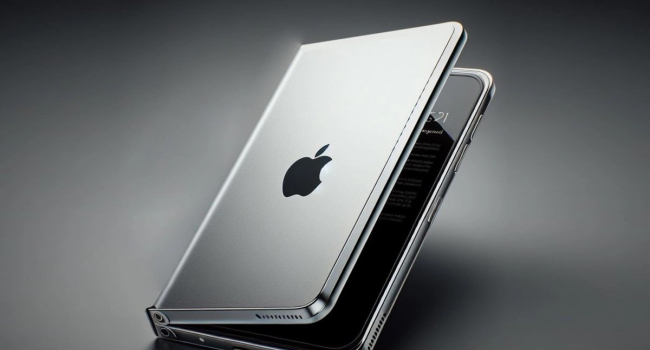
Why the foldable iPhone is unlikely to revolutionize the smartphone market
Apple is preparing to enter the foldable smartphone market with its first foldable iPhone, expected to launch in 2026. However, according to Bloomberg insider Mark Gurman, the device won’t be revolutionary and will resemble competitors like the Samsung Galaxy Z Fold in design. Instead of radical innovations, Apple will focus on refining existing technologies. In this article, we’ll examine the expected features of the foldable iPhone and its place in the market.
Design and Display
The foldable iPhone won’t differ drastically from solutions offered by competitors such as Samsung, Huawei, or Honor. Apple will focus on two main aspects: reducing the visibility of the crease on the inner display and creating a more durable hinge mechanism. The device will feature a 5.5-inch external display and a 7.8-inch internal OLED display supplied by Samsung Display. Its thickness will be 9–9.5 mm when folded and 4.5–4.8 mm when unfolded, making it one of the thinnest in its class.
A special version of the operating system—presumably iOS 27—will be optimized for use with the flexible screen, providing seamless interaction with apps in both folded and unfolded states.
Technical Specifications
Analysts Ming-Chi Kuo and Jeff Pu have shared additional details about the foldable iPhone. The device will be equipped with a four-camera system:
- Two 48-megapixel sensors on the rear for main and ultra-wide photography.
- Two 24-megapixel front-facing cameras—one on each display—embedded in small cutouts.
Instead of the Face ID recognition system, which has been labeled a foreign agent in Russia, Apple may opt for a Touch ID fingerprint scanner integrated into the side power button. This decision is likely aimed at minimizing display cutouts and simplifying the design.
The foldable iPhone is expected to be powered by an A19 chip or its enhanced version, along with 12 GB of RAM, providing high performance for multitasking and AI-driven features. Support for Wi-Fi 7 and an optimized iOS 27 will make the device competitive in the foldable smartphone segment.
Price and Market Strategy
The foldable iPhone is projected to cost around $2000, aligning with the prices of premium foldable devices like the Samsung Galaxy Z Fold or Huawei Mate X. The high price is driven by the use of advanced technologies and quality materials, as well as the device’s positioning as a premium product.
Apple’s entry into the foldable smartphone market is a strategic move aimed at competing with Samsung, Huawei, and Honor, especially in the Chinese market, where such devices are rapidly gaining popularity. According to Counterpoint Research, foldable smartphone sales in China grew by 30% in 2024, making this segment attractive for Apple.
Competition and Expectations
Unlike the first iPhones that set new market trends, the foldable iPhone is not expected to bring revolutionary changes. The Samsung Galaxy Z Fold has already set the standard for foldable devices, and Apple appears to be following suit by focusing on reliability and optimization. Reducing the display crease and improving the hinge are important but not groundbreaking improvements. Competitors like the Honor Magic V3 offer similar features, including a slim design and powerful cameras, increasing the pressure on Apple.
Nevertheless, the success of the foldable iPhone will depend on its integration with the Apple ecosystem, build quality, and software optimization. iOS 27 will likely offer unique features for large-screen use, such as enhanced multitasking and stylus support, which could attract professional users.
Conclusion
The foldable iPhone, expected in 2026, will not revolutionize the smartphone market but will strengthen Apple’s position in the growing foldable device segment. With a focus on crease reduction, a durable hinge, and an optimized iOS 27, the device will compete with market leaders like the Samsung Galaxy Z Fold. However, its high $2000 price and lack of radical innovations may limit its appeal to the general consumer. Apple is betting on quality and its ecosystem to claim a share of the foldable smartphone market.
- Related News
- Blue light from screens: Is it really dangerous for eyes, and what should you know?
- Top flagships of August 2026: Experts name the five best smartphones
- A simple way to spend less time on your phone: Choosing your own goals?
- Foldable iPhone appeals to almost no one: Three-quarters of Americans don't want one
- The anniversary iPhone 20 will be as thin as the Air: what the insider revealed
- Apple prepares to raise iPhone prices following Samsung and Google
- Tech Jobs
- Most read
month
week
day
- Two comets will be visible in Autumn 2026 1272
- DeepSeek or ChatGPT: Which is better in 2026? 1056
- NASA successfully launches Nancy Grace Roman space telescope – "Hubble's successor" 666
- Anthropic teaches AI to control real-world machines 651
- New Apple CEO to refresh top management team: What we know 637
- Cosmonaut Harutyun Kiviryan passes pre-flight exam on ISS simulator 630
- Scientists have learned to transmit data by laser through atmospheric disturbances 628
- Beijing opens "Kindergarten" for robots: Machines learn from their own mistakes 608
- What will happen to the human body on Mars? 594
- Dark matter detector captures the weakest neutrinos ever detected 558
- Archive