


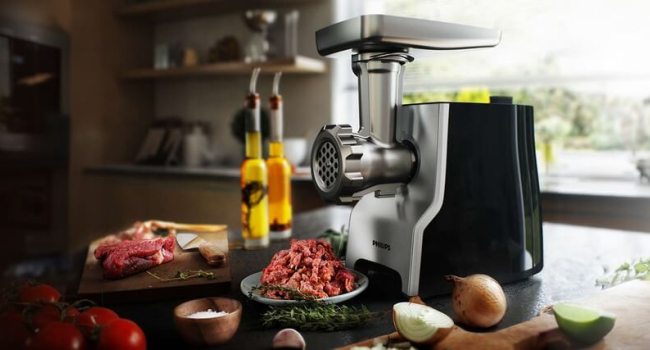
How to choose an electric meat grinder for home: A guide to features and models
An electric meat grinder is an indispensable kitchen helper, capable not only of preparing minced meat but also of shredding vegetables, making sausages, juicing, and even shaping cookies. In 2025, the market offers dozens of models, from budget-friendly to multifunctional. How do you avoid confusion and not overpay for unnecessary features? We explain what modern meat grinders can do, which parameters to pay attention to, and which models are worth considering.
What Can an Electric Meat Grinder Do?
Modern meat grinders are mini food processors, with capabilities depending on the set of attachments. Before buying, decide what you need the appliance for to avoid paying for extra functions. Here are the main tasks meat grinders can handle:
- Minced Meat: The standard attachment is a perforated disc (grid) with holes of different diameters (3–8 mm). Typically, 2–3 discs are included for coarse, medium, or fine grinding. For example, a 5 mm disc is suitable for cutlets, while a 3 mm disc is ideal for pâté.
- Homemade Sausages: An attachment with a narrow neck (10–20 mm diameter) for filling casings with minced meat. The set may include several attachments for sausages of different thicknesses.
- Vegetable Shredding: A drum with blades replaces the auger, slicing vegetables into pieces of varying thickness (1–5 mm). Suitable for salads and preserves.
- Grating: Cylindrical attachments with small or large holes for cheese, vegetables, or nuts. Usually includes two graters (2–4 mm).
- Shaped Cookies: A disc or mold with holes (stars, circles) for dough. Used for cookies, brushwood, or churros. • Kebbe: An attachment for hollow sausages stuffed with vegetables, mushrooms, or eggs. Popular in Middle Eastern cuisine.
- Juicer: Auger attachments for fruits and vegetables or conical citrus presses for oranges and grapefruits.
Attachment Tips:
• Choose solid metal attachments (stainless steel) — they are more durable than plastic and less likely to break.
• A “gear” (screw) attachment is more reliable than a plastic cap, which can crack.
Example: The Axion M 41.02 (~73 USD) includes attachments for minced meat (3 discs), sausages, kebbe, shredding, and grating, but no cookie disc. This is one of the best budget options from a Russian brand.
Key Selection Criteria
Beyond attachments, several parameters affect the convenience and durability of a meat grinder.
- Power Power (nominal, in watts) determines how easily the grinder handles tough meat, cartilage, or frozen products: • 400–600 W: For soft meat, vegetables, and small volumes (1–2 kg). Example: Polaris PMG 2582 (500 W, ~85 USD) processes 2.7 kg/min, has reverse function, and includes 3 minced meat discs. • 600–1000 W: A versatile option for home use, handling tendons and large portions. • 1000–2000 W: For intensive work, but excessive for home use (noisy and energy-intensive).
Tip: For a family of 3–4, 500–800 W with adjustable power is sufficient.
- Productivity Measured in kg/min (how much meat the grinder processes). The average is 1.5–2.5 kg/min: • Weissgauff WMG 673 BS (500 W, ~97 USD) delivers 2.5 kg/min, suitable for preserves or large families. • For home use, 1.5 kg/min is enough, as feeding meat faster is challenging.
Tip: High productivity is only needed for frequent cooking (dumplings, cutlets for a week).
- Continuous Operation Time The motor heats up during prolonged use, so manufacturers specify the maximum operating time: • 5–10 min: For small volumes (1–2 kg). • 10–15 min: For preserves. Example: Scarlett SC-MG45M25 (~49 USD) runs for 15 min, then needs a 10–20 min break. • 20+ min: Rare in household models.
Tip: For occasional use (1–2 times a week), 10 min is sufficient.
- Design and Materials • Body: Plastic (cheap but fragile) or metal (more expensive but reliable). A plastic-metal combination is optimal. • Tray: Metal (stainless steel) doesn’t absorb odors or darken, unlike plastic. • Bowl Height: 11–16 cm from the output to the base, to accommodate deep bowls. • Example: Hyundai HY-MG2322 (~49 USD) — plastic body, metal tray, 3 minced meat discs, sausage, and kebbe attachments.
- Safety and Maintenance • Reverse: The auger’s reverse motion dislodges tendons and stuck meat. Available in most models (Polaris, Weissgauff). • Overload Protection:
- Plastic Sleeve: Breaks during overheating (replacement needed, ~100 RUB).
- Circuit Breaker: Disconnects the circuit, allowing the appliance to cool.
- Thermal Element: Shuts off the motor during overheating.
- Self-Sharpening Blade: Convenient but less corrosion-resistant.
- Cleaning: Removable stainless steel or plastic parts can be dishwasher-safe.
- Rubberized Feet: Reduce vibration. Example: Kitfort KT-2108 (~73 USD) with reverse, thermal element, and rubberized feet.
- Related News
- How to choose a TV and not overpay for features you'll never use
- 4 key differences between modern washing machines and models from 5–10 years ago
- Why do modern TVs break faster than older ones?
- Direct sunlight can damage your TV: Why does this happen?
- Five gadgets that could change how we work in the kitchen
- A dream for office workers: Lenovo introduces the Yoga Silent Mouse — the quietest mouse on the market
- Tech Jobs
- Most read
month
week
day
- From Excel to AI: A startup by specialists who relocated from Iran to Armenia helps businesses make sense of their data 648
- The anniversary iPhone 20 will be as thin as the Air: what the insider revealed 626
- Top flagships of August 2026: Experts name the five best smartphones 589
- How NASA's primary training centre is changing in the era of commercial space stations 575
- Why Bill Gates is no longer an AI optimist: Three major threats of AI 558
- Robot knocks out teeth of five year old girl: Incident at Chinese museum leads to lengthy compensation dispute 548
- 10,000 tiny probes to Saturn's rings and robots in lunar caves: NASA funds 18 visionary ideas 492
- How to make your new smartphone more secure: expert tips 478
- Apple prepares to raise iPhone prices following Samsung and Google 471
- "Dark photons" back in play: scientists revise constraints on dark matter 463
- Archive