


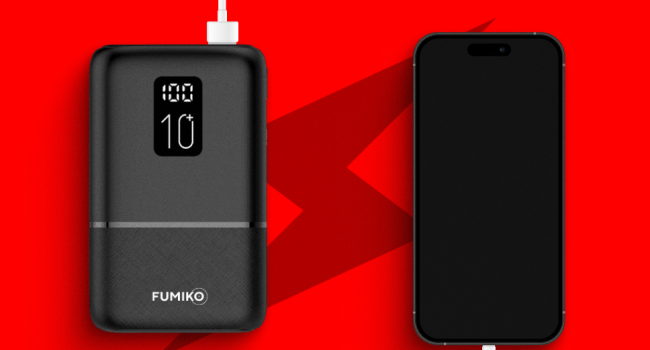
What to consider when choosing a power bank?
A power bank is an essential device in today’s world, keeping you connected in any situation. To select the right model, it’s worth considering key features that affect its convenience and efficiency.
Let’s explore the main factors to pay attention to.
Battery Capacity
The capacity of a power bank determines how much energy it can store and deliver to your devices. For instance, if your smartphone has a 5,000 mAh battery, opt for a power bank with at least 10,000 mAh. However, keep in mind that due to energy loss during transfer (typically 20–30%, depending on the device’s efficiency), a 10,000 mAh power bank will fully charge your phone once and leave about 60–70% for a second charge. If you plan to charge multiple devices or use the power bank for several days without recharging, consider models with 20,000 mAh or higher.
Maximum Current and Output Power
Charging speed depends on the maximum current and power supported by the power bank. The current can vary depending on the port type (USB-A, USB-C) or wireless charging capability. For example, a 3A current can yield different speeds based on voltage: at 5V, it delivers 15W, while at 9V, it jumps to 27W, significantly speeding up the process. Voltage is rarely specified, so it’s better to focus on output power in watts (W), which accounts for both current and voltage. For modern devices, opt for power banks with at least 20W output.
Number and Type of Ports
The convenience of a power bank largely hinges on the number and types of available ports. Most models come with multiple connectors, such as USB-A (traditional) and USB-C (modern and versatile). USB-C is often used both to recharge the power bank and to connect devices, making it highly practical. If you intend to charge multiple gadgets at once, look for models with two or three outputs. Some power banks also support Lightning inputs, which is a bonus for iPhone users.
Support for Fast Charging Protocols
If your devices support fast charging (e.g., Power Delivery or Quick Charge), ensure the power bank is compatible with these protocols. Popular standards include USB Power Delivery (PD), Qualcomm Quick Charge (QC), and proprietary technologies like OPPO’s VOOC. Before buying, check which protocols your smartphone or tablet supports and confirm their presence in the power bank’s specs. For example, charging modern iPhones at maximum speed requires USB PD support with at least 18W.
Additional Features
Beyond the core specs, consider these aspects:
- Weight and Size: A 10,000 mAh power bank is typically compact, weighing around 200–300g, while 20,000 mAh models may weigh 400–500g and be less pocket-friendly.
- Charge Indicator: A handy feature showing remaining power, either as a percentage or via LED lights.
- Wireless Charging: If your smartphone supports the Qi standard, a power bank with wireless charging can eliminate the need for cables.
Conclusion
Choosing a power bank depends on your needs: a lightweight 10,000 mAh model suits short trips, while a more powerful option is better for extended travel or charging multiple devices. Focus on capacity, power output, port types, and fast charging support—these factors will help you strike the perfect balance between functionality and convenience.
- Related News
- Samsung unveils monitor with record-breaking 1100 Hz refresh rate
- How to recover a corrupted USB flash drive: A practical guide
- Memory shortage hits the budget market: Why are smartphones under $100 disappearing from the market?
- Expert explains why smartphone storage quietly fills up
- How much RAM do you really need for gaming in 2026
- A full-fledged DLSS equivalent is coming to smartphones
- Tech Jobs
- Most read
month
week
day
- Two comets will be visible in Autumn 2026 1258
- DeepSeek or ChatGPT: Which is better in 2026? 1037
- NASA successfully launches Nancy Grace Roman space telescope – "Hubble's successor" 666
- Anthropic teaches AI to control real-world machines 650
- New Apple CEO to refresh top management team: What we know 634
- Scientists have learned to transmit data by laser through atmospheric disturbances 622
- Cosmonaut Harutyun Kiviryan passes pre-flight exam on ISS simulator 622
- Beijing opens "Kindergarten" for robots: Machines learn from their own mistakes 602
- What will happen to the human body on Mars? 587
- Dark matter detector captures the weakest neutrinos ever detected 549
- Archive