


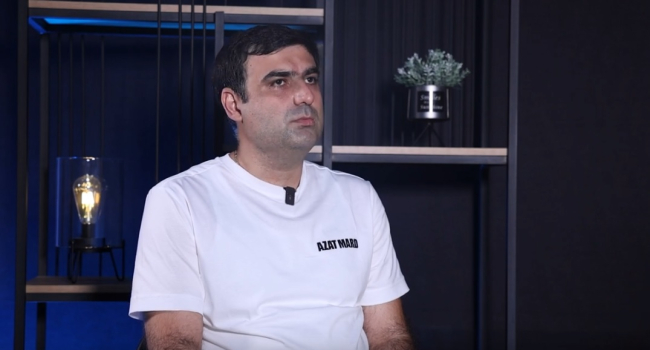
How many geologists does Armenia need and what problems may arise from their shortage? Interview with Sargis Kelyan
Several decades ago, the profession of a geologist was very popular both in the USSR and in Armenia. Today, the situation has changed, and the only faculty in our country that trains future geologists admits no more than a few applicants per year, which, of course, leads to a serious shortage of these specialists in the country.
Why are geologists so important for Armenia and what problems can their shortage lead to? What prospects are open to geologists today? How long does it take to study to become a geologist and is it expensive? NEWS.am Tech talked about all this with Sargis Kelyan, Dean of the Faculty of Geography and Geology at Yerevan State University.
Many people today have a wrong idea of the profession of a geologist: they think that a geologist is a specialist working in the mining industry. In fact, geologists, as Kelyan noted, work in many areas - from construction to research centers.
"For example, before starting construction, a conclusion from an engineer-geologist is required, who assesses the safety of the area for carrying out the relevant work. Against the backdrop of active construction in Yerevan, this is especially relevant today," the specialist said.
Geologists also deal with problems of underground water, landslides, seismology - and much more. And all these areas are extremely important for both the economy and the security of the country and its residents. If there is a shortage of geologists, all these industries may face serious problems, which will deal a significant blow to the economy and development of the country.
Studying to become a geologist: What you need to know
In Armenia today there is only one faculty that trains geologists.
"The Polytechnic Institute trains mining engineers, and the Academy of Sciences only has a master's program. But only we train bachelors," Sargis Kelyan noted.
On the one hand, this, of course, means that his department has no serious competition in the country. On the other hand, this indicates a low level of interest in this profession among the population. Indeed, the number of applicants is becoming smaller and smaller from year to year. This year, there were only 5-6 applicants in the geology specialty.
Today, according to the specialist, undergraduate studies last 4 years, master's studies - 2 years, and postgraduate studies - 3 years. The cost of education is approximately the same as the national average. At the same time, the faculty is allocated 9 places annually by state order. Students who have transferred from other universities or applicants who have returned from the army study on a fee-paying basis. However, the tuition of the latter is often compensated by the faculty's partners. Therefore, students usually do not have problems with paying for their education.
Why might studying to become a geologist be attractive?
Although few people today study to become geologists, the profession remains more than in demand, and geology students, according to Kelyan, will have no problems finding employment in the future. Today, there are already many companies that provide scholarships to the best students and are ready to hire them after graduation.
Moreover, many students who entered the Master's program already have highly paid jobs, but decided to continue their studies and deepen their knowledge.
Some partners of the faculty also provide cash rewards to the best students, which also becomes a good motivation for many.
As Sargis Kelyan noted, there are also interesting exchange programs, within the framework of which students go to other countries to study and gain experience, and for many this opportunity is also very interesting and attractive.
And if Armenia introduces a deferment from military service for guys entering this specialty, this will make studying at the faculty even more attractive and will help attract even more applicants.
- Related News
- From Excel to AI: A startup by specialists who relocated from Iran to Armenia helps businesses make sense of their data
- AI is already solving problems that mathematicians have worked on for decades: When will it learn logical reasoning? Interview with Perouz Taslakian
- How do large language models actually "think"? Interview with Erik Arakelyan
- Armenians have much to offer the world: A Qatari investor on choosing startups and Armenia's potential
- Not everyone needs to build the next unicorn: Why the world needs more than just startups? Interview with Helmut Kranzmaier
- Why startup–corporate collaboration often turns out to be a trap: Interview with Helmut Kranzmaier
- Tech Jobs
- Most read
month
week
day
- The anniversary iPhone 20 will be as thin as the Air: what the insider revealed 589
- From Excel to AI: A startup by specialists who relocated from Iran to Armenia helps businesses make sense of their data 578
- How NASA's primary training centre is changing in the era of commercial space stations 572
- Robot knocks out teeth of five year old girl: Incident at Chinese museum leads to lengthy compensation dispute 526
- Why Bill Gates is no longer an AI optimist: Three major threats of AI 515
- How to make your new smartphone more secure: expert tips 471
- Top flagships of August 2026: Experts name the five best smartphones 459
- 10,000 tiny probes to Saturn's rings and robots in lunar caves: NASA funds 18 visionary ideas 456
- "Dark photons" back in play: scientists revise constraints on dark matter 447
- Martian crater from The Martian captured in new detailed video 437
- Archive