





 make preferable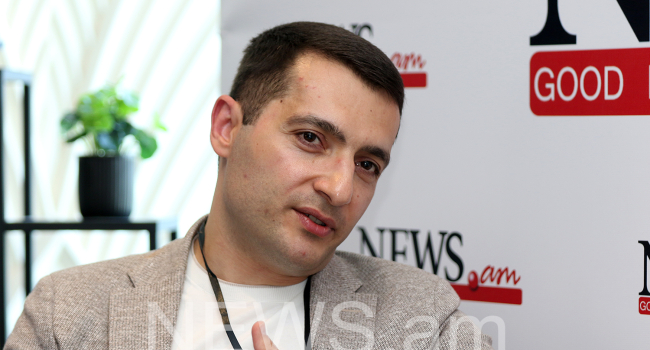
In the field of financial technologies, Armenia can reach Singapore if it uses all its opportunities correctly, said Armen Harutyunyan, a member of the board of the Global FinTech Institute which is engaged in discovering the potential of startups, a member of the academic board of the Singapore University of Social Sciences, in an interview with NEWS.am Tech. He was invited as a speaker to the Doing Digital Forumheld that was held in Yerevan and organized by SPRING PR company and coorganized by Ameriabank.
"Definitely," says Harutyunyan in response to the question whether Armenia has a chance to reach Singapore.
“The geopolitical position may require the country to pursue a complementary foreign policy. Armenia's geographical position enables it to become a connecting bridge. Here it’s about the provision of basic services. We [i.e., Armenia] have our hub opportunity in all domains and if we use it right, we will not become Singapore tomorrow, but every day we will become closer to both Singapore and Norway and other countries that, although not being rich, have been able to achieve great success based on knowledge and human capital," he says.
The Singapore University of Social Sciences, of which Armen Harutyunyan is a member of the academic board, develops education programs dedicated to the financial sector. However, as Harutyunyan notes, there are no education programs in Armenia that will provide a full-fledged diploma of a financial technology specialist. According to him, the financial education that is provided today in Armenia’s universities is quite traditional, it creates the necessary base for people to be engaged in banking, financial system, private and public spheres.
"But, unfortunately, at least I am not familiar with programs where the latest technologies are integrated; in particular fintech. Basically, today, except for short training programs that are implemented by various institutions, we do not have education programs that will give a full-fledged diploma as a specialist in financial technologies. Such a branch has been opened in our university in Singapore, and a student can get a qualification in financial technologies," he says, adding that they tried to start a joint program with the Matena school, which will not be a university, but a training program for financiers.
The Monetary Authority of Singapore—the central bank of the country—is also engaged in fintech development. The bank has created the APEX platform, which helps in the implementation of new technologies in financial organizations in developing countries.

According to Armen Harutyunyan, fintech essentially implies a change in the entire architecture.
"Our banking apps are quite appealing in terms of interface, but slow in terms of functions. Our goal is to solve two problems: What does a person need so that the transaction is fast, do not stand in lines, and be as affordable as possible? The only way to solve it is digitization because if you do the transaction from the factory, you don't stand in lines, you do it without a middleman, it means the downsizing of the staff," he says, adding that there is a bank in China and Singapore that has a limited number of employees and no branch.
"This is the maximum we should reach," he adds.
Programs used in the financial sector sometimes have complex interfaces with unclear instructions. In response to the question of what the consumer should do in this case, Armen Harutyunyan says that the user in the developed market has an alternative: there is an interface designed for the possessor of deeper knowledge, and there is an interface that is simpler and it is possible to switch from one to the other with one touch.
"There is no issue of protection, security here. All the bank or financial institution has to do is prepare two interfaces, which you will be able to switch with one button. My bank that I use in Singapore also has an option for the elderly who have difficulty using the [smart]phone. I believe the fears are due to the infrastructure that operates in the country," he says.
Armen Harutyunyan notes that this transformation happened faster in China because these instruments were simpler than cash.
"When a person realizes that he press on the QR code with his [smart]phone anywhere and pay, he learns quickly. But in our scene, unfortunately, this possibility does not exist at many service points, and a person does not know whether to keep cash with him, a card or a QR code. Today, the Singapore banks, which are developed, are also under pressure because every day a new tool appears and each one provides a solution. Fintech is very simple, people should not make it complicated, they just have to go and do it," he says.